
The Hidden Costs of Hiring BDRs vs Sales Automation Platforms
Published: 3/26/2026
Picture this: You're calculating the cost of hiring your first business development representative (BDR) and budgeting around $50,000 annually for salary. Fast forward six months, and you've spent over $85,000 with minimal pipeline to show for it. The hidden costs of recruitment, training, technology, and management time have blindsided your budget, and you're starting to wonder if there's a better way.
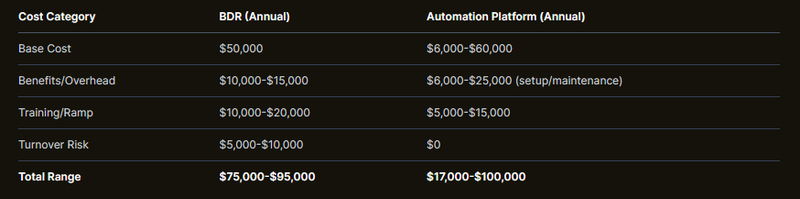
This scenario plays out in countless businesses every year. Hiring a single BDR can cost between $83,000-$213,000 annually when you factor in all hidden expenses. Meanwhile, sales automation platforms promise efficiency gains but carry their own substantial implementation and maintenance costs that many businesses drastically underestimate.
The challenge isn't just about choosing between human talent and technology. It's about understanding the true total cost of ownership for each approach and making a strategic decision that aligns with your business model, growth stage, and resource constraints. Companies using Local Leads solve this problem by using automated lead generation that works continuously without the overhead of hiring and managing staff, delivering consistent outreach for a fraction of traditional BDR costs.
Industry data reveals striking performance differences between these approaches. BDR turnover costs alone range from $10,000-$20,000 per replacement, while automation platforms can deliver 4-10x lower cost-per-meeting ratios. Some businesses report 70-95% cost savings when switching from human headcount to automated solutions for high-volume outreach activities.
This analysis will unpack the true costs of both approaches, reveal the hidden expenses that catch businesses off guard, and provide a framework for making the right choice based on your specific business requirements. You'll discover when human BDRs justify their substantial investment, when automation delivers superior ROI, and how smart businesses combine both strategies for optimal results.
Key Takeaways
- Hidden BDR costs can double or triple your expected hiring budget due to recruitment, training, and turnover expenses
- Sales automation platforms carry significant implementation and maintenance costs that many businesses underestimate
- Cost-per-meeting comparisons show automation typically delivers 4-10x better efficiency for high-volume outreach
- The best approach often combines both strategies, using automation for scale and humans for complex, high-value prospects
- Your business model, deal size, and sales cycle determine which approach delivers better ROI
The True Cost of Hiring BDRs: Beyond Base Salary
Recruitment and Startup Costs
The journey to hiring a BDR begins long before their first day, and these upfront costs add up quickly. Recruitment fees alone range from $5,000-$15,000 per hire, encompassing job board postings, recruiting agency fees, and the significant time investment required for interviewing and evaluation.
Once you've identified the right candidate, the salary represents just the beginning of your financial commitment. Fully loaded compensation includes the base salary plus 20-30% for benefits, payroll taxes, and administrative overhead. A $50,000 base salary translates to $60,000-$65,000 in total annual compensation costs before considering any performance bonuses or equity components.
Technology provisioning adds several hundred to several thousand dollars per representative annually. Each BDR requires CRM licenses, prospecting tool subscriptions, email infrastructure, communication platforms, and often specialized industry databases. These costs compound when you factor in user licenses for supporting tools like calendar scheduling, proposal software, and analytics platforms.
The hidden expense here is opportunity cost. While you're investing weeks or months in the recruitment and setup process, your competitors are actively generating pipeline and capturing market opportunities. This delay in market activation represents lost revenue that rarely appears in hiring cost calculations but significantly impacts overall ROI.
Onboarding and Ramp Time
Training represents one of the most substantial hidden costs in BDR hiring. Formal training programs typically cost $10,000-$20,000 per representative, covering product knowledge, sales methodology, prospecting techniques, and tool proficiency. This investment extends beyond monetary cost to include significant time commitments from senior team members who must dedicate 20+ hours per week during the ramp period.
The productivity timeline reveals the true cost of human scaling. Most BDRs require 1-3 months of structured onboarding before they can operate independently, followed by an additional 4-6 months to reach full quota contribution. During this extended ramp period, you're paying full compensation while receiving minimal pipeline generation.
Consider the mathematics: A $5,000 monthly total cost over six months of reduced productivity equals $30,000 in direct costs, plus the opportunity cost of meetings and pipeline that could have been generated during this period. If your target is 20 qualified meetings per month per BDR, you're potentially missing 60-120 qualified prospects during the ramp period.
The challenge intensifies when multiple BDRs are hired simultaneously. Training costs multiply, manager bandwidth becomes constrained, and the cumulative opportunity cost can represent significant competitive disadvantage during critical growth periods.
The Turnover Problem
BDR roles consistently rank among the highest turnover positions in business, with industry data showing annual attrition rates exceeding 30% in many sectors. Each failed hire triggers replacement costs of $10,000-$20,000, encompassing new recruitment expenses, additional training investments, and the compounding opportunity cost of extended pipeline gaps.
Performance statistics reveal that a substantial percentage of BDR hires fail to meet quota consistently. When underperforming representatives remain in roles for extended periods, the cost extends beyond their direct compensation to include wasted prospect touches, diminished team morale, and potential customer experience damage from inexperienced interactions.
The compounding effect becomes devastating for businesses experiencing repeated hiring cycles. A company that hires four BDRs annually with 50% turnover effectively pays for six to eight positions while maintaining consistent productivity from only four roles. This cycle creates a hidden tax on growth that can exceed 100% of planned hiring budgets.
Performance variability adds another dimension to turnover costs. High-performing BDRs often generate 3-5x more qualified pipeline than average performers, meaning that losing a top performer and replacing them with an average hire represents a permanent productivity reduction that affects long-term revenue generation.
Management Overhead and Intangible Costs
Beyond direct costs, BDR management requires substantial ongoing investment in coaching, performance management, and cultural integration. Sales managers typically spend 40-50% of their time on team development activities, representing opportunity cost in strategic initiatives and senior-level selling activities.
Cultural fit challenges create ripple effects throughout organizations. Poor hiring decisions can disrupt team dynamics, require additional management intervention, and create negative customer impressions that damage long-term relationship development. These intangible costs rarely appear in hiring budgets but significantly impact overall team effectiveness.
Customer experience implications deserve special consideration. Inexperienced or poorly trained BDRs can damage prospect relationships before they reach qualified stages, creating negative brand impressions that persist beyond individual employment periods. The cost of rebuilding damaged prospects relationships often exceeds the direct cost of the problematic hire.
While BDR costs are substantial and often underestimated, sales automation platforms bring their own set of hidden expenses that can catch businesses off guard.
Hidden Costs of Sales Automation Platforms
Implementation and Customization
Sales automation platform implementation extends far beyond monthly licensing fees. Custom development costs range from $10,000-$85,000+ depending on complexity, feature requirements, and integration needs. These expenses often surprise businesses that focus primarily on published subscription pricing during vendor evaluation.
Consulting fees represent a substantial portion of implementation budgets. Implementation partners typically charge $70-$300+ per hour, with projects requiring hundreds of hours for comprehensive deployment. The complexity increases dramatically when businesses require custom workflows, specialized reporting capabilities, or unique integration requirements that extend beyond standard platform functionality.
Project scope frequently expands during implementation as businesses discover additional requirements or realize that standard configurations don't meet their specific needs. Data migration alone can consume 15-20% of total implementation budgets, particularly when moving from legacy systems or consolidating multiple data sources.
Technical debt accumulates from heavy customization efforts. While custom development solves immediate needs, it creates ongoing maintenance requirements, complicates future upgrades, and often necessitates specialized technical support that extends far beyond standard customer success resources.
Integration and Ecosystem Expenses
Legacy system integration can add 40-60% to project scope, particularly for established businesses with existing CRM, ERP, or specialized industry software. These integration requirements often emerge late in implementation planning, creating budget surprises and timeline extensions that delay ROI realization.
Third-party connectors and premium marketplace applications generate recurring fees that compound over time. While individual app costs may seem modest, businesses often require multiple integrations to achieve desired functionality. These costs can quickly approach or exceed core platform licensing fees.
API limits and usage overages create surprise billing scenarios as automation volume increases. Platforms often structure pricing around usage metrics that are difficult to predict accurately during initial deployment. Successful automation campaigns can trigger overage charges that dramatically alter cost-per-lead calculations.
Middleware requirements add another cost layer for businesses with complex technical environments. Integration platforms or custom middleware solutions may be necessary to achieve smooth data flow between systems, representing additional licensing costs and technical maintenance requirements.
Training and Adoption Challenges
Training budgets typically represent 10-15% of total implementation costs but can escalate quickly for complex platforms or large user bases. Per-user training costs range from $500-$5,000 depending on platform complexity and customization requirements, creating substantial expenses for organizations with multiple users or high turnover rates.
Change management represents a hidden productivity cost during platform adoption. Even well-designed automation platforms require workflow changes and process adjustments that temporarily reduce team productivity. The learning curve can extend for months, during which teams operate at reduced efficiency while maintaining full compensation costs.
User resistance creates ongoing adoption challenges that require additional training investment and management attention. Poor initial adoption often necessitates retraining efforts, additional consulting support, and extended implementation timelines that multiply total cost of ownership.
The productivity paradox emerges when automation implementations initially decrease efficiency while teams learn new processes. This temporary productivity reduction can last several months and represents significant opportunity cost during critical business periods.
Ongoing Maintenance and Support
Annual maintenance fees typically represent 15-25% of license costs but can escalate based on customization complexity and support requirements. These recurring expenses often increase annually and represent permanent additions to operational budgets that must be factored into long-term ROI calculations.
Administrative personnel requirements frequently surprise businesses during automation scaling. Complex platforms often require dedicated administrators earning $80,000-$170,000 annually to manage system configuration, user support, data quality, and ongoing optimization efforts.
Vendor updates create recurring QA and reconfiguration costs. While platform improvements benefit users, they often require testing, training updates, and process adjustments that consume internal resources. Major updates can temporarily disrupt operations and require consulting support to implement properly.
Storage and scaling costs grow with success. Expanding data volumes, increased user counts, and additional feature requirements generate incremental costs that can substantially alter long-term platform economics. These variable costs make accurate ROI projections challenging during initial implementation planning.
Local Leads: The Set-and-Forget Alternative
At Local Leads, we eliminate the complexity and hidden costs that plague both traditional BDR hiring and enterprise automation platform implementations. Our automated lead generation approach operates continuously in the background, identifying and reaching out to new businesses in your target geographic area without requiring ongoing management or oversight.
The beauty of our system lies in its simplicity. While you're focused on serving existing clients and growing your business, we're automatically monitoring business registrations, identifying prospects that match your ideal customer profile, and initiating contact with professional, personalized outreach. This "set and forget" functionality means you maintain consistent pipeline development even during your busiest periods.
Our geographic targeting capabilities give you first-to-market advantage with new businesses in your area. While competitors rely on stale lead lists or manual prospecting efforts, we connect you with fresh prospects who haven't been contacted by dozens of other service providers. This first-mover advantage significantly increases close rates and reduces the competitive pressure that drives down pricing in saturated markets.
The cost comparison is striking. Our platform pricing ranges from $49-$99 monthly, delivering the equivalent outreach volume of a full-time BDR at less than 2% of the total cost. You receive complete contact information, automated email sequences, and geographic targeting without the recruitment hassles, training investments, or turnover risks that plague traditional hiring approaches.
We handle all the technical complexity that makes enterprise automation platforms expensive and difficult to implement. There's no need for custom development, system integration, or specialized training. Our platform includes built-in lead scoring, automated follow-up sequences, and performance tracking that provides immediate visibility into pipeline development activities.
For busy business owners who need consistent outbound activity but lack the bandwidth to manage complex sales processes, our solution delivers reliable results without the operational overhead. You maintain control over messaging and targeting while we handle the systematic execution that keeps your pipeline flowing consistently.
Performance and ROI Comparisons: What the Data Shows
Cost-Per-Meeting Analysis
Industry research consistently demonstrates dramatic efficiency advantages for automation over human-powered outreach. A key statistic emerges from comparative studies: $26 per meeting generated through AI-powered automation versus $262 per meeting through human BDR efforts. This 10x difference reflects the economics of scale and consistency that define automated prospecting.
The mathematics behind this efficiency gap become clear when examining resource allocation. Human BDRs dedicate significant time to research, list building, email composition, and follow-up tracking. Automation platforms handle these tasks instantaneously at scale, eliminating the time costs that drive up per-meeting expenses in human-powered processes.
These numbers apply most directly to high-volume, standardized outreach scenarios where messaging can be systematized and prospect qualification follows predictable patterns. The efficiency advantage diminishes in complex sales environments requiring extensive customization, relationship building, or technical expertise that automated systems cannot replicate effectively.
Cost-per-meeting calculations must account for total program costs including platform licensing, implementation expenses, management time, and ongoing optimization efforts. While the raw efficiency advantage heavily favors automation, total cost of ownership depends on volume requirements, implementation complexity, and the value of meetings generated through each approach.
Case Study Analysis
Real-world implementation data provides concrete insight into relative performance across different approaches. One documented case study involved a $15,000 investment testing AI-powered automation against traditional human BDR performance for equivalent outreach volume and target market conditions.
The automation approach generated $56,000 in influenced revenue at a total cost of $720, representing exceptional ROI efficiency. The human BDR simultaneously produced $147,000 in influenced revenue but required $39,000 in total compensation and support costs. This comparison reveals the primary trade-off between absolute revenue generation and efficiency metrics.
The human approach delivered 2.6x higher absolute revenue, demonstrating the relationship-building and qualification advantages that experienced sales professionals bring to complex prospect interactions. However, the automation approach achieved dramatically superior ROI, generating nearly 78x return compared to 3.8x return for the human approach.
Quality versus quantity considerations emerge clearly from this data. Human BDRs excel at identifying high-value opportunities and building relationships that convert to larger deals. Automation platforms maximize volume and efficiency but may sacrifice deal quality or conversion rates in scenarios requiring sophisticated prospect interaction.
Performance variability represents another critical factor. Human performance fluctuates based on motivation, skill development, market conditions, and personal circumstances. Automation platforms deliver consistent performance regardless of external factors, providing predictable pipeline generation that facilitates accurate forecasting and resource planning.
Volume and Scale Considerations
Automation platforms excel in high-volume scenarios where repeatable messaging and standardized qualification processes can be systematized effectively. The scale economics become attractive when businesses need to contact hundreds or thousands of prospects monthly with consistent messaging and follow-up sequences.
Human BDRs outperform automation in complex, relationship-driven sales environments where prospects require education, consultation, or customized solutions that extend beyond standardized messaging capabilities. The value proposition for human involvement increases directly with deal complexity and customer lifetime value.
Hybrid model implementations demonstrate the potential for combining both approaches strategically. Published studies show businesses using automation for initial outreach and qualification, followed by human follow-up for qualified prospects, achieving 2.5x more revenue and 9x ROI improvement compared to purely human-powered approaches.
Scale economics favor automation platforms as volume requirements increase. The marginal cost of additional automated outreach approaches zero, while human scaling requires proportional increases in compensation, training, and management resources. This creates attractive business cases for automation in high-growth scenarios.
Break-even analysis reveals that automation typically justifies investment at lower volume thresholds than human hiring. The fixed costs of platform implementation and setup can be amortized across large prospect volumes, while human scaling requires incremental variable costs for each additional contact capacity increase.
Understanding when each approach works best requires looking at your specific business model and sales requirements.
Decision Framework: When to Choose What
Choose Human BDRs When:
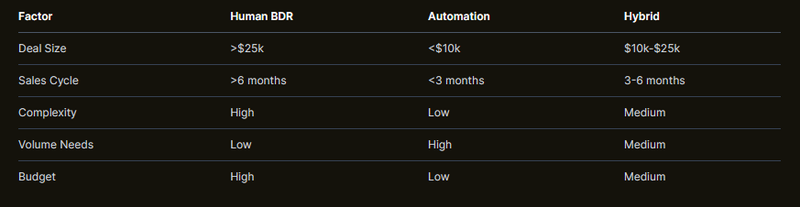
High-value, complex sales environments represent the primary scenario where human BDRs justify their substantial investment. Enterprise accounts requiring relationship building, trust development, and consultative selling approaches benefit significantly from experienced sales professionals who can navigate complex organizational structures and build consensus among multiple decision makers.
Long sales cycles create additional value for human involvement. When prospects require months of education, relationship building, and objection handling before making purchase decisions, the upfront investment in skilled BDRs often generates superior long-term returns compared to automated approaches that excel at initial contact but lack relationship development capabilities.
Consultative selling environments where prospects need education and guidance throughout the buying process favor human interaction. Complex service offerings, technical products, or innovative solutions often require explanation, demonstration, and customized positioning that automated systems cannot deliver effectively.
Industry expertise requirements create strong cases for human BDRs in specialized sectors. Technical knowledge, regulatory understanding, or deep industry experience becomes essential when prospects require credible consultation during evaluation processes. The expertise premium often justifies higher costs when deal sizes support the investment.
Calculate break-even points based on deal size and complexity to determine when human investment makes financial sense. Generally, average contract values exceeding $25,000 with sales cycles longer than six months create favorable economics for dedicated human resources.
Choose Automation When:
High-volume outreach scenarios represent the ideal application for automated prospecting platforms. Low to mid-ACV deals with repeatable messaging benefit significantly from automation's ability to contact thousands of prospects with consistent follow-up sequences at minimal incremental cost.
Speed to market advantages drive significant value in competitive environments where first-contact priority influences conversion rates. Automated systems can initiate prospect contact within hours of target identification, while human processes typically require days or weeks to achieve equivalent outreach volume.
Consistent activity requirements favor automation when businesses need reliable pipeline generation regardless of team capacity, vacation schedules, or employee turnover. Automated systems operate continuously without productivity variations that affect human-powered processes.
Resource constraints make automation attractive for businesses with limited budgets for hiring and training. The total cost of ownership for automation platforms often represents 20-30% of equivalent human resource costs while delivering comparable or superior volume metrics.
Geographic targeting and local market penetration scenarios benefit from automation's ability to monitor business registrations and market changes continuously. Local service businesses can maintain consistent outreach to new prospects without dedicating human resources to research and list development activities.
Hybrid Approach Best Practices
Strategic automation implementation uses automated systems for initial outreach and basic qualification, routing qualified prospects to human follow-up based on predetermined criteria. This approach maximizes volume efficiency while preserving human resources for high-value interactions.
Prospect segmentation by deal size and complexity enables resource optimization across different opportunity types. Automated systems handle smaller deals and initial qualification while human resources focus on complex, high-value prospects requiring relationship development and consultative selling approaches.
Continuous optimization based on performance metrics ensures resource allocation adjustments as market conditions and business priorities evolve. Regular analysis of cost-per-qualified-meeting and conversion rates enables strategic reallocation between automated and human approaches.
Resource allocation strategies should consider seasonal variations, market conditions, and business growth phases. Businesses may increase human resources during expansion periods while relying more heavily on automation during resource-constrained phases.
Practical Steps to Minimize Hidden Costs
If Choosing BDRs
Structured onboarding programs significantly reduce ramp time and improve new hire success rates. Standardized playbooks, role-playing exercises, and systematic skill development reduce the time to productivity while improving overall performance consistency across team members.
Early detection systems using performance scorecards help identify weak hires before significant additional training investments are made. Implementing 30-60-90 day evaluation checkpoints with clear performance metrics enables quick decisions about continued investment in underperforming hires.
Retention strategies including clear career pathing and performance-based incentives reduce turnover rates and associated replacement costs. Creating advancement opportunities within the organization and providing competitive compensation packages reduce the likelihood of successful performers leaving for competitor opportunities.
Technology stack optimization reduces per-representative costs by consolidating tools, negotiating volume discounts, and eliminating redundant software subscriptions. Regular audits of tool utilization ensure that technology investments deliver measurable productivity improvements rather than becoming cost centers.
If Choosing Automation
Budget planning should include 15-25% of annual license costs for ongoing maintenance and support requirements. This recurring expense often surprises businesses that focus primarily on implementation costs during vendor evaluation but represents a permanent addition to operational budgets.
Data quality investments during initial migration prevent ongoing operational problems and reduce long-term maintenance costs. Clean, standardized data reduces system errors, improves automation performance, and minimizes the technical support requirements that drive up total cost of ownership.
Integration planning must account for middleware, API limitations, and third-party connector costs that can substantially increase implementation budgets. Comprehensive technical requirements analysis during vendor evaluation prevents surprise expenses during implementation phases.
Human oversight allocation ensures that automated systems receive sufficient monitoring and optimization attention. Designating specific team members for system management prevents automation platforms from operating without sufficient performance monitoring and continuous improvement efforts.
Implementation Checklist
BDR cost calculations should include base salary plus 25-35% for benefits, training investments, ramp period productivity losses, and estimated turnover risks. Total cost of ownership calculations provide more accurate comparisons between human and automated approaches.
Platform budget planning must include licensing fees, customization costs, training expenses, ongoing maintenance requirements, and projected scaling costs. Comprehensive budgeting prevents implementation delays and ensures adequate resources for successful deployment.
Scenario modeling tests different assumptions for turnover rates, conversion performance, and market conditions. Sensitivity analysis helps identify break-even points and risk factors that could significantly impact ROI projections.
Pilot programs enable low-risk testing of different approaches with clear KPIs before committing substantial resources. Small-scale implementations provide performance data that informs larger strategic decisions while minimizing potential losses from poor vendor selection.
Performance tracking focuses on cost-per-qualified-meeting and pipeline influence metrics rather than activity volume alone. Meaningful success metrics ensure that resource allocation decisions optimize revenue generation rather than activity levels.
Making the Right Choice for Your Business
The analysis reveals substantial hidden costs on both sides of the BDR versus automation decision. Traditional hiring approaches can easily double or triple initial budget projections when recruitment, training, turnover, and management overhead are properly calculated. Automation platforms carry significant implementation and maintenance costs that many businesses underestimate during vendor evaluation.
The 4-10x efficiency advantage of automation for volume outreach activities represents a strong economic reality for businesses focused on scale and consistency. However, this advantage diminishes significantly in complex sales environments requiring relationship building, technical expertise, or consultative approaches that automated systems cannot replicate effectively.
Quality versus quantity trade-offs define much of the decision framework. Human BDRs excel at building relationships, handling complex objections, and identifying high-value opportunities that justify their substantial investment. Automation platforms maximize outreach volume and consistency while maintaining dramatically lower costs per contact and qualified meeting generated.
Strategic segmentation often provides the optimal approach for growing businesses. Different prospect types, deal sizes, and complexity levels may justify different resource allocation strategies within the same organization. Using automation for high-volume, standardized outreach while preserving human resources for complex, high-value prospects often delivers superior overall performance.
The decision framework should emphasize cost-per-qualified-meeting and pipeline ROI as primary success metrics. While activity volume and efficiency metrics matter, revenue generation and profit contribution represent the ultimate measures of program success. Hidden costs significantly impact these calculations and must be included in strategic planning.
Start with automation for most businesses due to lower implementation risk and faster time to value. The reduced complexity, lower capital requirements, and predictable performance characteristics make automation platforms ideal for initial pipeline development efforts. Human resources can be added strategically as deal complexity and business growth justify additional investment.
Scale considerations become critical as businesses grow. Automation platforms provide linear scaling capabilities without proportional increases in management complexity or variable costs. Human scaling requires careful planning for recruitment, training, and performance management that can strain organizational resources during rapid growth phases.
Regular evaluation and adjustment ensure resource allocation remains optimal as business priorities, market conditions, and competitive environments evolve. Neither approach represents a permanent decision, and successful businesses continuously optimize their prospecting strategies based on performance data and changing requirements.
Focus on pilot testing and measurement rather than comprehensive commitments during initial implementation phases. Both approaches benefit from systematic testing with clear success metrics before scaling to full operational deployment. This reduces risk while providing performance data that informs larger strategic decisions.
Calculate your true BDR costs using the frameworks provided in this analysis, accounting for all hidden expenses that affect total cost of ownership. Compare these comprehensive costs against automation platform alternatives including implementation, maintenance, and scaling expenses to make informed decisions based on complete financial pictures.
Consider starting with clear KPIs and measurement systems regardless of the approach selected. Cost-per-qualified-meeting, pipeline influence, and ROI metrics provide objective evaluation criteria that enable continuous optimization and strategic adjustment as business requirements evolve.
The future belongs to businesses that can combine human expertise with automated efficiency strategically. Understanding when each approach delivers superior value enables resource allocation decisions that maximize both efficiency and effectiveness while maintaining sustainable growth trajectories in competitive markets.
Frequently Asked Questions
What's the real total cost of hiring a BDR for the first year? The true first-year cost typically ranges from $83,000-$125,000, including base salary ($50-60k), benefits and payroll taxes (20-30%), recruitment fees ($5-15k), training and ramp costs ($10-20k), technology provisioning ($2-5k), and management overhead. Many businesses budget only for salary and are surprised by these additional expenses.
How long does it take for automation platforms to show ROI compared to hiring BDRs? Automation platforms typically demonstrate positive ROI within 2-4 months due to immediate activity generation and lower upfront costs. BDRs require 4-8 months to reach positive ROI due to extended ramp periods, training investments, and higher compensation costs. However, successful BDRs may generate higher absolute revenue over time in complex sales environments.
Can small businesses afford sales automation platforms with all the hidden costs? Yes, but careful planning is essential. While enterprise platforms can cost $50,000-100,000+ annually with implementation and maintenance, many small business solutions like Local Leads operate at $500-1,200 annually. The key is matching platform complexity to actual needs rather than over-investing in enterprise features that small businesses don't require.
What's the break-even point between BDR costs and automation investment? The break-even typically occurs when deal sizes exceed $15-25k with sales cycles longer than 4-6 months, or when outreach volume exceeds 500+ prospects monthly. Below these thresholds, automation usually delivers superior ROI. Above them, human relationship-building capabilities often justify the additional investment.
How do I avoid the most expensive mistakes when choosing between BDRs and automation? Start with pilot programs using clear performance metrics before making large commitments. Budget for total cost of ownership including hidden expenses on both sides. Focus on cost-per-qualified-meeting rather than activity volume. Consider hybrid approaches that use automation for initial outreach and humans for qualified prospect follow-up to optimize both efficiency and effectiveness.