
How to Find New Businesses in My Area: Get a List of New Businesses with Lead Generation Tool
Published: 1/8/2026
Most B2B companies face the same frustrating challenge: by the time they discover new businesses in their area, competitors are already knocking on their doors. Timing is everything in business development, yet most business owners and sales teams rely on outdated methods like Google Maps, Chamber directories, and purchased lists that show businesses months after they've already chosen their vendors.
The solution lies in finding newly registered businesses using modern lead generation tools and alternative strategies that give you a first-mover advantage. When you contact a business within 3 months of registration, you're not competing against established relationships - you're helping solve real-time needs.
Before going into solutions, here are the most important points you need to know.
Key Takeaways
Timing beats volume: Newly registered businesses convert 3-5x better than established companies because they actively need services and haven't locked in vendors yet.
Traditional methods fail: Google Maps provides limited business details, requires tedious manual research for each contact, offers no insight into recent openings, and has no option to bulk export, making it very time-consuming. Chamber directories are months behind, and purchased lists are shared with competitors.
Lead generation tools win: Local Leads makes finding new businesses fast and simple. It filters by registration date and location, giving you a live view of newly registered companies in your target area. That means you can reach out at the right time, to the right businesses, without wasting hours on manual research.
Public records are free: Government business registries in the US (Secretary of State portals) and Canada (provincial corporate registries) provide verified new business data at no cost. However, they often include only basic info and require manual extraction.
Early outreach advantage: Contacting businesses within 3 months of registration yields higher response rates and faster decisions.
Why Finding New Businesses Near Me Is So Hard
Three main challenges plague B2B companies searching for new businesses locally. The manual search problem consumes hours on Google Maps with no way to identify which businesses just opened. Google doesn't indicate when businesses are registered, making it impossible to distinguish between new and established companies.
Chamber of Commerce directories update quarterly at best. This means "new" businesses are already 6-12 months old by the time they appear in these directories. By then, new business owners have already researched vendors, made purchasing decisions, and established working relationships.
The purchased list trap creates false hope. Companies buy "exclusive" lists that are actually sold to dozens of competitors simultaneously. Research shows that 40% of purchased business lists contain outdated information within 90 days. This creates a cycle where sales teams waste time contacting closed businesses or reach prospects already overwhelmed with identical outreach.
Studies show that 73% of new businesses make vendor decisions within their first 90 days of operation. Missing this window means competing against established relationships rather than being first to market.
Understanding why new business leads are so valuable makes the search worthwhile.
Why New Business Leads Matter More Than Established Ones
Newly registered businesses represent superior leads because new business owners are actively setting up operations, researching vendors, and making purchasing decisions. Unlike established companies with locked-in relationships, new businesses haven't developed vendor loyalty yet.
Response rates tell the story: new businesses respond to outreach 2-3x more than established companies because they genuinely need services. New business owners make faster decisions, typically within 2-4 weeks compared to 3-6 months for established businesses, because they can't afford operational delays.
The "helpful timing" factor transforms your outreach from interruption to assistance. When you contact a new business owner who genuinely needs your service, your message feels helpful rather than intrusive. This positioning creates immediate rapport and interest.
Live Lists ensure you’re seeing every newly registered business in your area as soon as they appear in official records, so you can take action immediately while they’re actively seeking solutions.
New businesses have a 45% higher email open rate and 60% faster decision-making timeline compared to established companies. These advantages compound when you're first to reach them.
Despite these advantages, most lead generation methods miss the mark.
Problems With Traditional Lead Generation Methods
Google Maps & Manual Search Issues
Manual lead generation is tedious and time-consuming. Emails aren’t always visible, websites must be visited for full contact details, and LinkedIn or social media often needs checking for decision-makers. Only a few results appear per page, and refreshing or navigating away can lose your place entirely. Filtering by industry or location is limited, forcing you to sort out irrelevant leads manually.
The process requires visiting individual business listings, checking websites for establishment dates, and piecing together limited information, which scales poorly and provides no real competitive advantage.
Live lists remove this problem by continuously capturing new registrations from official sources as they happen, eliminating hours of manual research.
Chamber of Commerce & Directory Limitations
Chambers update their directories quarterly or annually, meaning "new" listings are already 3-12 months old. Chamber directories focus on networking rather than sales intelligence, providing limited contact information and no indication of business needs or timing.
Most Chamber listings lack email addresses, direct phone numbers, or decision-maker names. The networking focus means businesses join when they're ready to participate in community events, not when they need vendor services.
Purchased List Problems
Purchased lists fail for finding truly new businesses because most providers update monthly at best. "New business" lists are often recycled and sold to multiple buyers simultaneously. By the time a business appears on a purchased list, dozens of competitors have already contacted them.
List providers rarely verify data accuracy or registration dates. What's marketed as "new businesses" often includes companies registered 6-18 months ago.
Live Lists are continuously verified against official registries, so you avoid outdated information and avoid competing against dozens of other companies using the same list.
Free Public Records
Government business registries in the U.S. (Secretary of State portals) and Canada (provincial corporate registries) provide verified new business data at no cost. County clerks, city licensing departments, and regional economic development agencies may also maintain business license lists. While these sources are free and reliable, they usually include only basic contact information and require significant manual effort to extract, organize, and prioritize leads.
Whether it’s manually browsing Google Maps, waiting for Chamber updates, buying lists, or combing through public records, these approaches are slow, tedious, and often produce outdated or incomplete leads.
Timing is critical in B2B prospecting, and relying on these methods makes it nearly impossible to reach businesses early before competitors secure them.
Why Most Lead Lists Become Outdated Quickly
Small businesses change rapidly. They move locations, update phone numbers, change websites, or even close within months of opening. Most lead generation tools refresh their databases monthly or quarterly, creating gaps where information becomes stale.
Business registration happens daily, but most tools only capture this data in batch updates. This delay means you're always working with yesterday's information when timing matters most.
B2B data decay happens when business data accuracy decreases every quarter due to changes in contact information, location, or business status. What matters most is timing, accuracy, and local relevance - three factors that traditional lead lists consistently miss.
This is where modern lead generation tools change the game.
Introducing Local Leads: A Better Way to Find New Businesses Near Me
Local Leads is a lead generation tool built to help you find newly registered businesses filtered by target industry and location. Designed for small to mid-sized B2B companies, it provides accurate, current data that’s easy to filter by industry and location. Unlike outdated directories or purchased lists, Local Leads gives you a live view of all business registrations in a specific area so you can reach prospects when they’re most receptive, helping you send timely, relevant outreach before competitors.
The competitive advantage comes from reaching businesses within days of registration rather than months.
The tool focuses specifically on timing, which is why it consistently outperforms broader business databases for new business prospecting. Whether you're targeting startup leads in Vancouver or manufacturing leads in Toronto, this specialized tool provides better results.
How Local Leads Finds New Businesses Better
Smart Lead Generation
Local Leads generates high-quality leads using verified business registration data and public record-based filtering. You define the industry and location you want to target, and Local Leads produces a curated list of new business prospects that match your criteria. All data comes from official registries and is continuously updated, ensuring your outreach is timely and accurate.
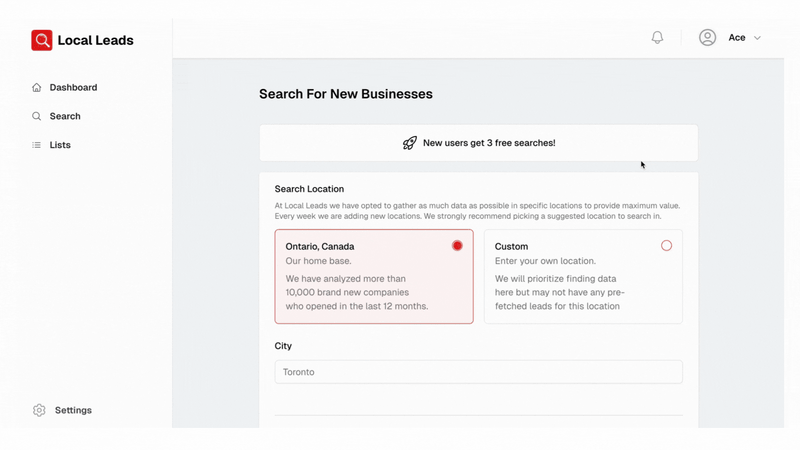
Targeted Industry and Location Filtering
Advanced filters let you focus on specific cities or industries. This ensures every lead aligns with your ideal customer profile, reducing irrelevant outreach and keeping your sales efforts highly targeted.
Verified Contact Information
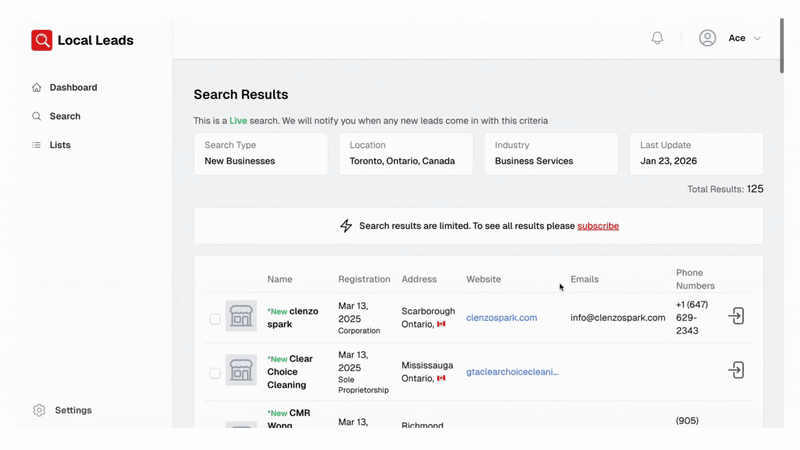
Each lead is enriched with contact details, including emails, phone numbers, and social media handles/links when available. This allows your team to reach decision-makers directly without wasting time hunting for information.
Live Lists for Timely and Relevant Leads
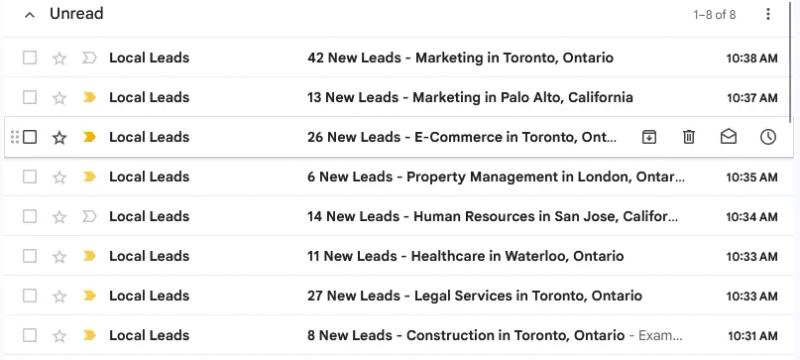
Because Local Leads constantly monitors searches and updates results, you can act quickly while prospects are most receptive. You create a live list that matches exactly what you’re looking for using current data, and it continues to update as new businesses register or pop up. This gives you a real competitive advantage by contacting companies early in their registration lifecycle—before they’ve locked in vendors or been contacted by everyone else.
Why Live Lists Give You the First-Mover Advantage
Live Lists are continuously updated with verified registration data, so you don’t need to manually refresh or wait for monthly or quarterly updates. Because the data comes from official registries, it’s authentic and real-time, giving you a true first-mover advantage. By contacting businesses as soon as they appear, you increase your chances of engagement and secure clients before competitors even know they exist.
How Local Leads Works (Step-by-Step Guide to Finding New Business Leads)
Step 1: Define Your Role
Choose whether you’re using Local Leads as an individual or on behalf of a business. You can optionally provide your company name and size.
Step 2: Provide Your Website (Optional)
If you have a website, Local Leads can automatically gather information about your products or services. This helps generate highly relevant leads tailored to your offerings.
Step 3: Describe Your Products or Services
Include multiple products or detailed descriptions. Local Leads uses this information to identify the best target industries and opportunities automatically.
Step 4: Specify Your Industry
Select your industry as well as the industries you want to target for outreach.For example, a marketing agency might select Marketing Services as their industry and target Home Services or Construction businesses, while a software company might select Software / Technology and target Accounting Firms or Legal Offices for outreach.
Step 5: Choose Your Target Area
Pick the city, state/province, and country where you want to find new businesses. Combine this with your target industries for precise lead generation.
Step 6: Live or Static Search
Decide if you want a continuously monitored live search that updates with new leads as they register, or a static, one-time search. Live lists are constantly updated as new businesses register. Static lists are useful for one-time campaigns, but live lists ensure you’re always contacting businesses as soon as they appear, before competitors.
Step 7: Access Your Lists
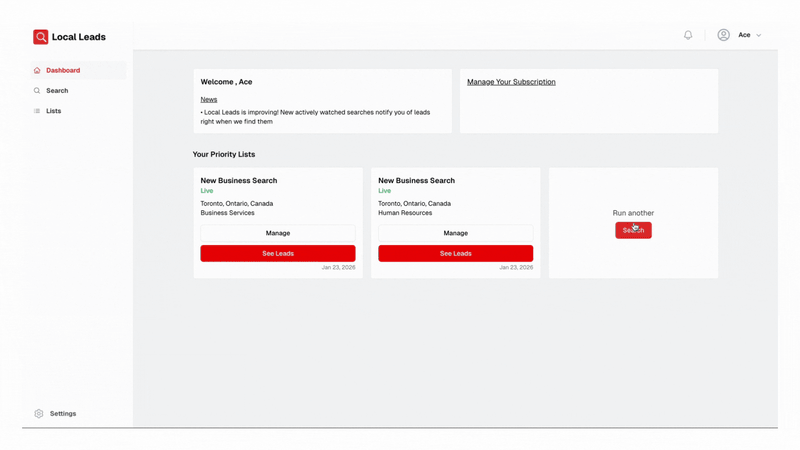
View all previously created lead lists in one place for easy management. Options include:
- New Businesses – Find newly registered companies in a specific industry and location.
- Local Industry Search – Search all businesses in a particular industry within a local area.
This turns hours of research into minutes, letting you act quickly and beat your competitors.
What to Expect: Data Quality and Results
Set realistic expectations about data quality, response rates, and conversion timelines. Newly registered businesses provide more accurate contact information and respond faster, but may need time to establish budgets and operational processes.
Typical response rates reach 10-15% for cold outreach to new businesses compared to 2-3% for established companies. Conversion timelines average 2-8 weeks versus 3-6 months for established businesses.
The quality advantage comes from timing rather than volume. Fewer prospects with better timing beat larger lists of stale data.
The results speak for themselves when comparing new versus established business outreach.
Why Newly Registered Businesses Convert Better
New business owners actively seek solutions for real-time challenges. New restaurant owners need POS systems immediately. New law firms require IT support before opening. New retail stores need marketing services to drive initial traffic, including specialized services like real estate leads in Boston for property-focused businesses.
Early outreach positions you as a helpful resource rather than another salesperson. New business owners appreciate vendors who find them quickly, viewing it as a sign of industry expertise and proactive service.
The psychological advantage is significant. When your outreach solves a current problem or addresses a need, prospects are more receptive, creating higher response rates and faster conversions.
How to Engage New Companies in Your Area (Best Practices)
When reaching out to newly registered businesses, your goal is to add value and establish authority from the first interaction. Approaching these leads thoughtfully will set you apart from competitors who rely on generic outreach.
Best Outreach Tips:
- Personalize based on business type: Reference what they do and tailor your message to their industry or niche.
- Reference their recent launch: Acknowledge that they’re new by congratulating them or highlighting a relevant service that supports their early growth.
- Keep messages short and helpful: Busy business owners appreciate concise, actionable communication.
- Focus on solving an immediate need: Address a specific pain point or challenge that comes with starting a new business.
- Avoid aggressive sales language: Position yourself as a helpful resource, not a pushy salesperson.
These principles help you build trust quickly, increasing the likelihood of a positive response and long-term engagement.
The Best Sales Steps to Convert New Business Leads
Turning newly registered businesses into clients requires a structured approach. Following these steps ensures your outreach is timely, relevant, and effective.
- Identify relevant new businesses: Use tools like Local Leads to filter by industry, location, and registration date.
- Prioritize by registration timing: Focus on companies registered within the last 1-6 months to maximize responsiveness.
- Reach out early: Contact leads as soon as possible while they’re actively setting up operations and making vendor decisions.
- Follow up thoughtfully: Maintain a consistent, non-intrusive follow-up schedule to stay top-of-mind.
- Track responses and refine messaging: Monitor which outreach approaches generate engagement and adjust your messaging accordingly.
By combining timely action with personalized, helpful messaging, your sales team can convert more leads and establish early, lasting relationships with new businesses.
Ready to gain the competitive advantage of early outreach?
Start Finding New Businesses First
The competitive advantage belongs to companies that find and contact new businesses before competitors do. Timing beats volume in B2B sales, and the tools and methods outlined provide that important timing advantage.
Stop wasting time on outdated methods that show you months-old "new" businesses. Start reaching new businesses first, while they're actively making vendor decisions and before relationships form with competitors.
Sign up for Local Leads today and get access to live, verified new business leads immediately.
Your next qualified lead registered somewhere in your area today. The question is whether you'll find them first.
FAQs
Local Leads Tool FAQs
How easy is it to organize and export leads?
Super easy. Local Leads keeps all your lists in one place and lets you export them for outreach. No more copying from directories or spreadsheets.
How do you find new leads?
Local Leads finds newly registered businesses in your target industry and area. You can use public records too, but that takes more time.
How often is the list of new businesses updated?
All the time. Local Leads updates continuously, so you always have fresh leads.
Which industries can I target?
Any industry you want. You choose what’s relevant for your business.
Is this better than buying lead lists?
Yes. Local Leads gives you real, verified new businesses that your competitors probably haven’t contacted yet.
Can I find businesses near me only?
No, you can find businesses near you and beyond! Giving you the control to focus on hyperlocal or begin expanding outwards.
Is this suitable for small sales teams?
Absolutely. Even a small team can quickly generate high-quality leads with Local Leads.
Lead Engagement & Timing FAQs
How soon should I contact a new business?
Within 30-90 days. That’s when they’re setting up operations and making decisions, so you’ll have the best chance to help.
How often should you follow up?
Be consistent but not pushy. Every 3–5 days for the first few messages, then once a week if needed.
How quickly should you follow up with a lead?
The sooner, the better. Early contact shows you’re helpful and proactive.
What is the 2‑2‑2 rule in sales?
It’s a follow-up plan: first follow-up 2 days after the first contact, second follow-up 2 weeks later, and a final check-in 2 months later.
What is the 5-minute rule for leads?
Contact new leads within 5 minutes if you can. The earlier, the better the response.
How many leads per day is good?
Depends on your team. For small teams, 10–20 high-quality leads a day works well. Quality beats quantity.
Lead Generation Strategy FAQs
Are free public records as good as paid tools?
They’re accurate, but not as convenient. Paid tools like Local Leads save time and give you verified contacts ready to reach out to.
Are lead generation tools worth it?
Yes. They save time, give verified leads, and help you reach businesses before competitors.
Is it worth paying for leads?
Definitely. Paying for Local Leads gives you fresh, accurate, and relevant contacts so your team can focus on selling.
Which tool is best for lead generation?
Local Leads is considered the best in terms of price and value because it finds newly registered businesses in your area with verified contact info and gives you a live list of leads so the data is always up to date.
How many new businesses register each month?
Depends on your area. Cities might see 50–300, smaller towns 10–50. Check local databases for a baseline.