When to Automate Lead Generation: The Complete Guide to Timing Your Investment
Published: 4/14/2026
Most businesses know they should automate lead generation, but 73% implement it at the wrong time—either too early when they lack the foundation, or too late when they've already lost countless opportunities.
Manual lead generation becomes overwhelming as businesses grow. Teams struggle to balance lead follow-up with core business activities. Traditional automation seems complex and time-consuming to implement. Many businesses miss the optimal timing window for automation.
This guide reveals the exact signals that indicate it's time to automate, the risks of waiting too long, and how modern solutions like Local Leads make automation accessible even for busy teams who need results fast. Based on industry research from leading sales automation platforms and real-world case studies from 2023-2025.
Key Takeaways
- Volume triggers automation: When lead volume consistently exceeds your team's manual capacity, automation prevents lost opportunities
- Time-to-contact is critical: Automated systems can reduce response times from hours to minutes, dramatically improving contact rates
- Local focus amplifies results: Geographic targeting combined with automation creates first-to-market advantages
- Start simple, scale smart: Begin with basic automation and expand based on proven results
- ROI comes from timing: The right automation at the right time can reduce customer acquisition costs by 40-60%
The Clear Warning Signs It's Time to Automate
Lead Volume Exceeds Manual Capacity
Key Indicator: Leads are left unattended or response times consistently slip beyond 24 hours
Research shows that companies responding within 5 minutes are 9x more likely to convert leads. When monthly lead volume grows faster than team capacity, automation becomes essential. B2B technology firms in 2024 saw 40% pipeline lift after automating qualification processes.
Sales Team Drowning in Administrative Tasks
The 50% Rule: If sales reps spend over half their time on qualification and admin tasks instead of selling
Data entry, research, and low-value outreach consume selling time. Companies using automated qualification report 35% increase in actual selling time. Your top performers shouldn't be stuck doing data entry and research tasks that machines handle better.
Conversion Rates Below Benchmark or Declining
Warning Signs:
- MQL to SQL conversion rates below industry standards (typically 13-27%)
- Lead to customer conversion consistently under 2%
- Month-over-month decline in funnel performance despite steady lead flow
When your processes can't keep up with lead volume, quality prospects slip through the cracks. Automation ensures consistent qualification and follow-up for every lead.
Cost Per Lead and Customer Acquisition Costs Rising
Financial Triggers:
- CPL exceeding budget thresholds by 20% or more
- CAC trending upward despite marketing optimization efforts
- Manual processes creating inefficiencies that inflate costs
These warning signs don't appear overnight. Understanding the underlying business benefits helps explain why addressing them through automation delivers measurable ROI.
The Business Case: Why Automation Delivers Results
Efficiency and Time Savings
Automation eliminates repetitive tasks like data entry and basic qualification, allowing teams to focus on high-value activities and strategic selling. Salesforce reduced paid channel costs by 40% through workflow automation by removing manual bottlenecks that were inflating customer acquisition expenses.
Scalability Without Linear Growth
Handle growing lead volumes without proportional staff increases. Scale across multiple channels simultaneously. Geographic expansion becomes manageable with automated systems that can process leads 24/7 across different time zones and markets.
Improved Lead Quality Through Better Scoring
Multi-dimensional qualification using firmographics, behavioral data, and intent signals ensures consistent scoring criteria across all leads. Higher-intent prospects get immediate attention while lower-quality leads receive appropriate nurturing sequences.
Faster Response Times and Consistent Follow-up
Automated routing ensures sub-hour response times. Standardized cadences prevent lead decay. Automated systems improve contact rates by 60-80% over manual processes by eliminating human delays and ensuring every lead receives timely follow-up.
While the benefits are clear, automation isn't right for every situation. Understanding when to wait or take a hybrid approach prevents costly mistakes.
When Automation Might Not Be Right (Yet)
Highly Consultative Sales Requiring Personal Relationships
Complex B2B sales depending on senior-executive relationships often require human touch from the first interaction. Bespoke demos and extended consultative engagement can't be fully automated. Best practice: Use automation for support tasks like scheduling and follow-up reminders, not replacing human contact in relationship-building phases.
Poor or Incomplete Data Quality
Automation amplifies bad data problems. If your CRM is filled with incomplete contact information, duplicate records, or outdated company data, automation will simply scale these problems. CRM hygiene must come before automated scoring and routing. Action item: Prioritize data enrichment and cleanup first, or choose solutions that include data verification.
Limited Budget or Immature Technology Stack
Basic processes like lead capture, CRM hygiene, and qualification rules should be established first. Complex platforms require ongoing maintenance investment. Without proper foundation processes, automation becomes another operational burden rather than a solution.
Risk of Losing Brand Voice and Personalization
Over-templated outreach can feel robotic and actually decrease engagement rates. Many businesses see response rates drop when they implement automation without maintaining human oversight and dynamic personalization. Solution: Maintain human oversight and dynamic personalization in automated sequences.
For businesses ready to move forward, understanding which specific processes to automate first creates the foundation for success.
What to Automate First: The Smart Sequence
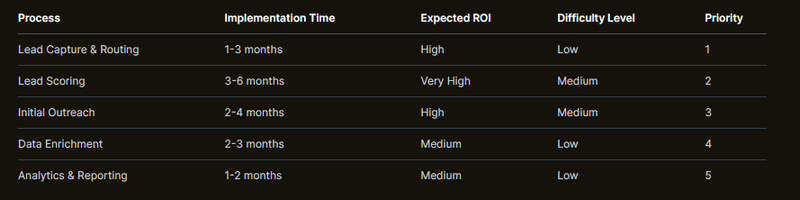
Lead Capture and Routing (Priority #1)
Web forms automatically feeding CRM with instant routing based on geography, industry, or company size creates immediate efficiency gains. Implementation timeline: 1-3 months for quick wins. This foundation enables all other automation processes.
Lead Scoring and Initial Qualification (Priority #2)
Rule-based scoring using firmographic data combined with behavioral signals from website activity and email engagement. Expected outcome: 25-40% improvement in MQL to SQL conversion. This separates high-intent prospects from tire-kickers automatically.
Initial Outreach and Follow-up Sequences (Priority #3)
Triggered email sequences based on lead source with multi-touch cadences ensuring consistent contact. Calendar integration for smooth booking removes friction from prospect engagement. This maintains momentum after initial qualification.
Data Enrichment and Verification (Priority #4)
Auto-enrichment for company size, technology stack, contact information with real-time data verification to improve deliverability. Enhanced personalization through better data quality enables more relevant outreach at scale.
Analytics and Performance Tracking (Priority #5)
Automated reporting on key metrics provides real-time visibility into pipeline health. Continuous optimization based on performance data ensures your automation improves over time rather than becoming stagnant.
Automation Priority Matrix
Understanding the sequence is important, but for local businesses and service providers, there's a solution that addresses the complexity challenge head-on.
How Local Leads Solves the Automation Complexity Problem
The reality is that most lead generation automation feels overwhelming because it requires multiple integrations, complex setup processes, and ongoing technical maintenance. That's exactly why I built Local Leads differently.
Our "Set and Forget" Approach
Instead of spending months setting up complex automation workflows, our platform works naturally and immediately:
- Continuous monitoring: We automatically find new local businesses in your target industries and locations
- Human-like outreach: Our automated emails feel personal and conversational, not robotic
- Geographic focus: Local targeting means higher relevance and better response rates
Why Sooner Is Better with Local Leads
Unlike traditional automation that requires extensive setup time, Local Leads delivers value from day one:
- First-to-market advantage: We contact new businesses within hours of them appearing online
- No technical complexity: Web-based platform requires no integrations or technical setup
- Complete contact data: Phone numbers, email addresses, and social profiles automatically collected
Built for Busy Business Owners
I understand that outbound prospecting falls off when you get busy with client work. Our automation ensures:
- Consistent pipeline: Lead generation continues even when you're focused on service delivery
- Quality over quantity: Geographic and industry filtering means every lead is relevant
- Immediate action: Start generating leads today, not in three months after complex setup
Real-world impact: Our clients typically see their first qualified leads within 48 hours of setup, with close rates improving substantially due to being first in the prospect's inbox.
Whether you choose Local Leads or another solution, having a clear decision framework helps determine the right timing for your specific situation.
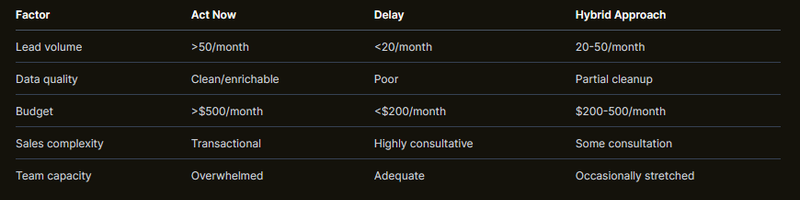
Your Decision Framework: Act Now or Wait?
Act Now If You Have:
Clear Automation Triggers:
- Steady or growing monthly lead volumes overwhelming manual processing
- Sales team spending over 50% of time on qualification rather than closing
- Conversion rates below industry benchmarks with documented late follow-up issues
- Clean enough CRM data or budget for enrichment to support automated scoring
Financial Justification:
- Marketing spend over $5,000/month with unclear ROI on lead sources
- Customer acquisition costs trending upward month-over-month
- Manual processes creating bottlenecks that limit growth potential
Delay or Use Hybrid Approach When:
Relationship-Dependent Sales:
- Complex B2B deals requiring senior executive relationships early
- Highly consultative sales with extended decision cycles
- Recommendation: Use automation for support tasks, not primary outreach
Infrastructure Limitations:
- Poor data quality that would amplify automation errors
- Budget constraints preventing sustained investment in maintenance
- Basic processes (CRM hygiene, qualification rules) not yet established
The Local Business Advantage
Geographic targeting provides unique benefits:
- Higher relevance scores improve email deliverability
- Local businesses more likely to respond to local service providers
- Reduced competition in geographic niches
Decision Checklist
Once you've decided to move forward, measuring the right metrics ensures your automation investment pays off.
Measuring Success: KPIs That Matter
Response Time and Contact Rate Metrics
Primary Indicators:
- Lead response time (target: under 5 minutes for hot leads)
- Contact rate percentage (goal: 40-60% improvement over manual)
- Email deliverability and open rates
Conversion Quality Metrics
Pipeline Health:
- MQL to SQL conversion rate (benchmark: 13-27% depending on industry)
- SQL to closed-won conversion (should maintain or improve)
- Average deal velocity and sales cycle length
Cost and ROI Metrics
Financial Performance:
- Cost per lead (CPL) trending downward over 6-12 months
- Customer acquisition cost (CAC) improvement
- Revenue per automated lead vs. manual lead
Data Quality and Coverage
Operational Metrics:
- Percentage of leads with complete contact information
- Data accuracy rates for enriched fields
- Integration uptime and system reliability
Key Statistics to Track:
- Time to first contact: Aim for under 1 hour for automated routing
- Follow-up consistency: 100% of leads should receive scheduled follow-up
- Lead scoring accuracy: Measure actual conversion rates by score ranges
- Geographic relevance: Track response rates by proximity and local relevance
- Cost efficiency: Monitor CPL reduction over time
Success requires more than just implementing technology—it demands ongoing optimization and best practices.
Implementation Best Practices for Long-Term Success
Start Small and Iterate
Pilot Approach:
- Begin with one channel or customer segment
- Measure outcomes over 90-day periods
- Expand based on validated wins and proven ROI
Maintain Human Oversight
Hybrid Workflows:
- Automation handles capture, enrichment, and initial scoring
- Human reps manage qualified conversations and complex discussions
- Regular review of automated messaging for brand consistency
Continuous Testing and Optimization
Message Performance:
- A/B test subject lines, send times, and personalization tokens
- Monitor engagement rates across different message variations
- Update templates based on response data and feedback
Data Hygiene and Enrichment Standards
Quality Maintenance:
- Weekly CRM cleanup and duplicate removal
- Regular validation of contact information accuracy
- Third-party enrichment for missing firmographic data
Clear Qualification Rules and SLAs
Sales and Marketing Alignment:
- Joint definition of MQL and SQL criteria
- Response time commitments (typically 1-4 hours for hot leads)
- Escalation procedures for high-value prospects
Compliance and Governance
Regulatory Requirements:
- GDPR/CCPA compliance for data collection and processing
- Opt-in/opt-out management systems
- Regular audits of data usage and consent records
Timeline Expectations:
- Quick wins (1-3 months): Basic routing and response time improvements
- Medium-term (3-9 months): Measurable conversion rate improvements and CPL reduction
- Long-term (9+ months): Sophisticated scoring models and advanced personalization
Understanding realistic timelines helps set proper expectations for automation ROI.
Timeline and Investment Expectations
Quick Wins (1-3 Months)
Immediate Improvements:
- Automated form-to-CRM connection
- Basic lead routing rules
- Standard drip sequences
- Expected results: 50-80% improvement in response times
Medium-Term Returns (3-9 Months)
Substantial Process Improvements:
- Lead scoring model deployment
- Multi-channel outreach sequences
- Data enrichment integration
- Expected results: 25-40% improvement in MQL to SQL conversion rates
Long-Term Optimization (9-24+ Months)
Advanced Automation:
- AI-driven qualification and scoring
- Sophisticated personalization at scale
- Full inbound content automation
- Expected results: 40-60% reduction in overall customer acquisition costs
Investment Levels by Company Size
Small Businesses ($49-199/month):
- Basic automation with geographic targeting
- Essential integrations and follow-up sequences
- Limited customization but immediate value
Mid-Market ($200-999/month):
- Advanced scoring and multi-channel automation
- Custom integrations and reporting
- Dedicated support and optimization
Enterprise ($1,000+/month):
- Full-scale automation across multiple business units
- Custom AI models and advanced personalization
- White-glove implementation and ongoing optimization
ROI Timeline Expectations:
- Month 1-3: Process efficiency gains and time savings
- Month 4-9: Measurable conversion rate improvements
- Month 10+: Significant cost reduction and revenue growth
With clear expectations set, the decision comes down to choosing the right approach for your specific business situation.
Making Your Automation Decision
The question isn't whether to automate lead generation—it's when and how to do it right. The warning signs are clear: when lead volume exceeds manual capacity, when sales teams spend more time on admin than selling, or when conversion rates plateau despite marketing efforts, automation becomes essential for growth.
The key insights from our analysis:
- Timing matters more than perfection: Waiting for perfect data or processes often means missing opportunities
- Local targeting amplifies results: Geographic relevance significantly improves response rates and conversion quality
- Simple automation beats complex delays: Basic automation implemented quickly outperforms sophisticated systems implemented slowly
For local businesses and service providers, the traditional complexity barrier has been removed. Modern platforms like Local Leads prove that automation can work naturally and immediately, without months of technical setup or ongoing maintenance headaches.
Your next steps:
- Assess your current situation using the decision framework provided
- Calculate your automation ROI potential based on current lead volume and costs
- Choose your approach: comprehensive platform for immediate results or gradual implementation of individual components
- Start measuring from day one to validate and optimize your automation investment
The businesses that win in 2026 and beyond won't be those with the most sophisticated automation—they'll be the ones who implemented the right automation at the right time, with consistent execution and continuous optimization.
The cost of waiting often exceeds the cost of starting. Every day you delay automation, competitors gain first-contact advantages with prospects in your market. The question isn't whether you can afford to automate—it's whether you can afford not to.
Ready to take the next step? Your leads are waiting, and your competitors aren't standing still.
FAQ
When should I start automating if I'm getting less than 20 leads per month?
Focus on improving lead generation volume first. With fewer than 20 leads monthly, manual processes are typically manageable and automation overhead may exceed benefits. However, if those leads are high-value ($10k+ deals), automation can still be worthwhile for ensuring perfect follow-up consistency.
How do I know if my data quality is good enough for automation?
Your data is ready for automation if you have accurate email addresses for 80%+ of leads, company names for 90%+ of B2B leads, and contact phone numbers for 60%+ of prospects. Missing data can be enriched through automation, but incorrect data will scale problems.
What's the difference between marketing automation and lead generation automation?
Marketing automation nurtures existing leads through email sequences and content delivery. Lead generation automation finds new prospects, captures their information, and handles initial outreach. Most businesses need both, but lead generation automation typically delivers faster ROI.
Can automation work for complex B2B sales that require relationship building?
Yes, but with a hybrid approach. Use automation for lead capture, initial qualification, data enrichment, and scheduling. Human reps should handle discovery calls, demos, and relationship building. Automation supports the sales process without replacing human expertise.
How long before I see ROI from lead generation automation?
Quick wins appear within 30-60 days through improved response times and consistency. Measurable conversion improvements typically show within 3-6 months. Full ROI realization usually occurs within 6-12 months as processes optimize and costs decrease.