
Cold Email Psychology: What Makes B2B Prospects Respond in 2026
Published: 3/3/2026
Picture this: Your sales team sends 500 cold emails per week, but your inbox remains eerily quiet. Sound familiar? You're not alone. B2B reply rates have plummeted to just 3.4-5.8% in 2026, yet some emails consistently break through the noise and generate meaningful responses.
The difference isn't better templates or fancier tools. It's understanding the psychological factors that actually drive decision-making in today's hyper-competitive business environment.
Traditional volume-based cold email approaches fail because they ignore basic human psychology. They treat prospects like email addresses instead of decision-makers with specific cognitive patterns, biases, and psychological triggers that influence their behavior.
Companies like Local Leads are solving the timing challenge by automatically reaching prospects first, using the psychological advantages that come with early contact. But timing is just one piece of the puzzle.
This article explores the cognitive biases, messaging frameworks, and psychological strategies that separate emails that get responses from those that get deleted. We'll examine anchoring bias, social proof triggers, the psychology of first impressions, and how AI-powered personalization can activate psychological responses at scale.
Success in 2026 cold email depends on understanding buyer psychology, not just perfecting templates. The companies winning in today's market are those that combine psychological insight with technical excellence, creating messages that connect on a human level while using systematic approaches that scale.
Key Takeaways
- Cognitive biases drive responses: Anchoring, social proof, and authority triggers influence B2B email responses more than product features or pricing alone
- Hyper-personalization creates psychological relevance: Using recent business signals and specific company references bypasses spam filters and activates engagement psychology
- Timing advantages matter significantly: First-contact positioning and new business targeting improve response rates by using psychological receptivity windows
- AI-powered personalization at scale: Modern tools can activate psychological triggers like reciprocity and curiosity while maintaining authentic human connection
- Technical factors impact trust psychology: Deliverability, sender reputation, and domain authority create subconscious trust signals that influence response decisions
The Psychology Behind B2B Email Responses: Core Cognitive Biases
Understanding Decision-Making Biases
B2B prospects aren't rational decision-makers. They're humans operating under cognitive biases that significantly influence their email response behavior. Three critical biases shape how prospects evaluate cold emails:
Overconfidence bias causes prospects to overestimate their ability to spot valuable opportunities quickly. This means your email has roughly 7 seconds to prove its worth before getting dismissed. Prospects assume they can identify relevant messages instantly, leading them to make rapid judgments based on limited information.
Confirmation bias makes prospects more likely to respond to emails that align with their existing beliefs or current priorities. Messages that challenge their worldview or contradict their current strategy face immediate resistance. Smart cold emailers frame their solutions within the prospect's existing mental models.
Planning fallacy causes prospects to underestimate the time needed to implement solutions, making them more receptive to "quick wins" and immediate benefits. This bias explains why emails promising long-term transformation often fail while those offering rapid implementation succeed.
Anchoring Bias in Email Messaging
Anchoring bias influences 73% of professional decision-making scenarios, making it one of the most powerful psychological triggers in cold email. This cognitive bias causes people to rely heavily on the first piece of information they receive when making decisions.
In email context, anchoring works by setting a reference point that influences how prospects evaluate your entire message. Instead of writing "We can help reduce your costs," effective emails specify: "Based on similar companies in your industry, most achieve $50,000 in annual savings within 90 days."
The specific anchor ($50,000) creates a mental framework for evaluation. Even if the prospect's potential savings differ, they'll judge your offer relative to that initial anchor point.
Examples of effective anchoring in cold email:
- Revenue anchors: "Companies like yours typically see $75K additional revenue in Q1"
- Time anchors: "Most implementations complete in 2 weeks, not the 6 months you might expect"
- Efficiency anchors: "Your team could save 15 hours per week on manual processes"
Social Proof and Authority Triggers
Social proof and authority triggers reduce skepticism by using our natural tendency to follow others' behavior, especially those we perceive as credible. Research shows that authority and social proof increase response likelihood by 40%.
Effective social proof in cold email goes beyond generic client lists. It requires strategic matching of proof elements to prospect psychology:
Industry-specific proof: "We've helped 23 SaaS companies in the 50-200 employee range increase their qualified leads by an average of 340%."
Role-specific authority: "Your CMO counterparts at [Similar Company] and [Another Similar Company] both mentioned this challenge during our recent industry roundtable."
Outcome-specific credibility: "After implementing our system, [Client Name] eliminated the exact bottleneck you mentioned in your recent conference presentation."
The key is making social proof feel personally relevant rather than generic. Prospects need to see themselves in your success stories to activate the psychological triggers that drive response behavior.
The Science of First Impressions: Subject Lines and Opening Psychology
Subject Line Psychology in 2026
Subject lines operate in a psychological attention economy where prospects make split-second decisions about email relevance. Key finding: Subject lines under 7 words that evoke curiosity outperform generic ones by 65%.
The psychology behind effective subject lines uses curiosity gap theory – creating an information gap that the human brain naturally wants to close. However, 2026 prospects have developed sophisticated filters for obvious curiosity tricks, requiring more refined approaches.
Recent company event references consistently outperform generic value propositions because they activate recognition psychology. When prospects see their company name or recent business events in subject lines, their brains automatically categorize the message as personally relevant rather than mass marketing.
Examples of psychological subject line triggers:
- Pattern interruption: "[Company]'s Series A timing" (when they just announced funding)
- Curiosity with relevance: "Quick question about [specific initiative]"
- Authority positioning: "Insight from [competitor] implementation"
- Social proof implication: "Following up on [industry event] conversation"
Avoid subject lines that trigger spam psychology: excessive punctuation, all caps, obvious sales language, or generic phrases like "increase revenue" or "save money."
Opening Line Psychology
The first sentence determines whether prospects continue reading or immediately delete your email. Hyper-personalization psychology explains why specific references build rapport – humans are naturally drawn to information that feels personally crafted for them.
The psychology of recognition creates a moment where prospects feel "seen" as individuals rather than anonymous targets. This recognition triggers reciprocity psychology, making them more likely to invest attention in your message.
Research insight: Leadership changes and strategic initiative references increase engagement by 3x compared to generic opening lines. This works because these references prove you've invested time understanding their specific situation, which activates the reciprocity principle.
Effective opening line psychology:
- Recent trigger: "Saw the announcement about your expansion into the Seattle market..."
- Strategic insight: "Given your focus on operational efficiency this quarter..."
- Authority positioning: "Your presentation at [Event] about [Topic] connected with challenges we're seeing across [Industry]..."
The psychological transition from attention to interest requires smoothly connecting personal relevance (opening line) to business relevance (your solution). This bridge prevents the mental disconnect that causes prospects to stop reading.
Message Structure Psychology: Problem-Agitate-Solve Framework
The Psychology of Problem Recognition
Activating existing pain points without creating defensiveness requires understanding cognitive dissonance psychology. Prospects resist messages that make them feel incompetent or suggest they've been making poor decisions.
Effective problem recognition frames current situations as rational responses to previous circumstances while highlighting how those circumstances have changed. This approach preserves ego while creating openness to solutions.
Best practice: Messages under 125 words maintain attention spans while allowing sufficient space for psychological development. Longer emails trigger "too much effort" psychology, leading to immediate deletion or "save for later" behavior that rarely converts.
Instead of: "Your current lead generation strategy isn't working." Try: "Most companies built their lead generation systems 2-3 years ago, before AI personalization became viable at scale."
This framing acknowledges their intelligence while positioning your solution as responding to new market realities rather than fixing their mistakes.
Agitation Techniques That Work
Status quo bias makes prospects comfortable with current solutions, even when better options exist. Effective agitation disrupts this comfort without triggering defensiveness.
Fear of missing out (FOMO) in B2B contexts requires specific, competitive framing rather than generic urgency. Social comparison theory explains why competitive messaging works – humans naturally evaluate their position relative to peers.
Effective agitation psychology:
- Competitive positioning: "While [Competitor] has been gaining market share with [specific advantage]..."
- Opportunity cost framing: "Each month without [solution] means [specific loss] compounds..."
- Peer comparison: "Companies similar to yours report [specific advantage] from [action]..."
The key is creating urgency through external market forces rather than artificial deadlines or pressure tactics that trigger skepticism.
Solution Positioning Psychology
Reciprocity principle activation requires offering genuine value before asking for anything. This could be insights, tools, or strategic perspectives that prospects can implement regardless of whether they buy from you.
Risk reversal psychology reduces decision-making anxiety by minimizing perceived downside. In cold email, this means low-commitment calls-to-action that feel like information gathering rather than sales meetings.
Key statistic: Simple, value-driven CTAs increase response rates by 45% compared to meeting requests. Examples include:
- "Worth a 10-minute conversation to share what we learned from [similar situation]?"
- "Happy to send you the framework we developed for [specific challenge] – no strings attached."
- "Quick call to walk you through the analysis we did for [similar company]?"
These CTAs activate curiosity while minimizing commitment psychology that creates resistance.
Timing Psychology and Competitive Advantage
The Psychology of Timing in B2B Outreach
Primacy effect psychology explains why first contact matters significantly in B2B sales. When prospects encounter a new challenge or opportunity, the first credible solution they encounter creates an anchor point for evaluating all subsequent options.
Fresh opportunity bias makes new businesses especially receptive to outreach because they haven't yet established preferred vendor relationships or developed decision-making fatigue around specific challenges.
Research finding: New businesses are 4x more likely to respond in their first 30 days of operation because they're actively building systems and relationships. This psychological window represents maximum receptivity before competitive clutter creates decision paralysis.
The psychology of timing extends beyond company age to include trigger events:
- Funding rounds create urgency psychology around growth initiatives
- Leadership changes open windows for strategic reevaluation
- Market expansions trigger solution-seeking behavior
- Competitive pressures create receptivity to advantage-building tools
Local Leads Solution: Using Timing Psychology
Our automated lead generation platform ensures first-contact advantage by continuously monitoring for new local businesses and automatically sending personalized outreach during peak receptivity windows.
We use the psychological principle that new businesses operate with fresh opportunity bias – they're actively seeking solutions rather than defending existing choices. This timing advantage, combined with geographic relevance, creates optimal psychological conditions for response.
Our system maintains consistent psychological presence without human resource drain. While competitors rely on manual prospecting that creates timing gaps, our automation ensures we reach prospects during their most receptive psychological state.
Geographic targeting creates additional psychological relevance through local authority positioning. Prospects naturally trust local service providers more than distant competitors, activating familiarity and community connection psychology.
The "set and forget" automation maintains psychological consistency that builds recognition over time. Consistent presence creates familiarity psychology that increases trust and response likelihood without requiring manual effort from our clients.
AI-Powered Personalization: Scaling Psychological Triggers
The Technology Behind Psychological Personalization
Modern AI analyzes firmographic, technographic, and behavioral data to create personalization that mimics human psychological insight. The technology identifies patterns in prospect behavior, company characteristics, and industry trends that activate specific psychological triggers.
Dynamic message creation uses these insights to craft emails that feel individually researched and written. The AI selects psychological frameworks based on prospect profile, recent business activity, and industry-specific buying patterns.
Key insight: AI personalization tools increase reply rates by 60% through psychological relevance that would be impossible to achieve manually at scale. The technology activates multiple psychological triggers simultaneously while maintaining message coherence.
Psychological Triggers at Scale
Reciprocity through valuable insights: AI identifies industry trends, competitive analysis, or operational insights that provide immediate value to prospects. This activates reciprocity psychology by giving before asking.
Curiosity through pattern recognition: Advanced systems identify unusual patterns in prospect behavior or industry positioning that create natural curiosity gaps requiring resolution through conversation.
Social proof through automated case study matching: AI matches prospect characteristics with relevant client success stories, creating personalized social proof that activates trust psychology.
Authority through industry-specific expertise demonstration: The technology references industry-specific challenges, terminology, and trends that position senders as knowledgeable insiders rather than generic vendors.
These psychological triggers work because they address core human needs: feeling understood, staying informed, reducing risk, and making good decisions relative to peers.
Avoiding Uncanny Valley Effects
Over-personalization can trigger suspicion psychology when prospects sense information that feels too intimate or indicates excessive surveillance. The uncanny valley effect in AI personalization occurs when messages feel simultaneously personal and artificial.
Balance requires maintaining human psychological connection despite automation. This means using AI insights to inform human-feeling communications rather than creating obviously algorithmic content.
Research finding: Over-personalization can reduce response rates when prospects feel their privacy has been invaded or when personalization feels manipulative rather than helpful.
Best practices for authentic AI personalization:
- Reference publicly available information only
- Focus on business relevance rather than personal details
- Maintain professional tone that suggests human review
- Use personalization to add value, not demonstrate surveillance capabilities
Advanced Psychological Frameworks for 2026
Signal-Based Psychology
Business signals create natural psychological urgency because they represent moments when companies actively need solutions. Effective signal-based outreach requires understanding the psychology behind different trigger events.
Funding rounds activate growth psychology – recipients are actively seeking tools and services that support scaling. Leadership changes create strategic reevaluation psychology where new decision-makers want to implement their vision. Geographic expansion triggers systematic thinking about operational efficiency and market entry strategies.
Table: Psychological Triggers and Response Rates
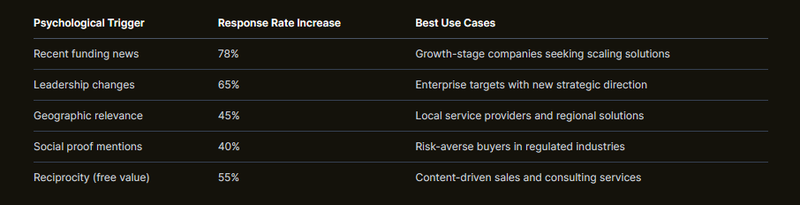
These triggers work because they align outreach with existing psychological states rather than creating artificial urgency.
Overcoming Psychological Barriers
Skepticism and spam fatigue require strategic approaches that acknowledge and address prospect psychology directly. Trust-building through technical credibility demonstrates competence without appearing pushy.
Pattern recognition avoidance prevents messages from feeling templated or mass-produced. This requires varying message structure, personalization points, and value propositions even when targeting similar prospects.
Effective barrier-overcoming strategies:
- Acknowledge skepticism: "I know you probably get a lot of emails about [topic]..."
- Demonstrate technical understanding: Reference specific industry challenges or technical requirements
- Offer easy exit options: "If this doesn't apply to your current situation, just let me know and I'll stop reaching out"
The Psychology of Follow-Up Sequences
Persistence versus annoyance psychology requires understanding how prospects process repeated contact. Research insight: 7-touch sequences with varied psychological approaches achieve 15% response rates compared to 3% for single-touch campaigns.
The key is varying psychological angles rather than repeating the same message. Different touches should activate different cognitive biases and decision-making frameworks:
Touch 1: Curiosity and relevance Touch 2: Social proof and authority Touch 3: Reciprocity through value Touch 4: FOMO and competitive pressure Touch 5: Problem recognition and consequences Touch 6: Risk reversal and low commitment Touch 7: Final value offer with clear exit
This sequence works because it acknowledges that different psychological triggers connect with the same person at different times and in different contexts.
Technical Psychology: How Deliverability Affects Trust
The Psychology of Technical Trust
SPF, DKIM, and DMARC authentication create subconscious trust signals that influence prospect behavior before they consciously evaluate your message content. Critical statistic: 89% of prospects make subconscious trust decisions based on technical factors they may not even consciously recognize.
Email clients use technical authentication to determine message placement (inbox vs. spam), which affects psychological context. Messages that reach the inbox are automatically perceived as more legitimate than those requiring rescue from spam folders.
Sender reputation affects psychological credibility through association with previous positive or negative email experiences. Poor technical setup triggers pattern recognition that associates your message with unwanted communications.
Domain Authority and Psychological Credibility
New domain psychology creates skepticism because prospects associate established domains with legitimate businesses. Warming strategies build psychological trust by demonstrating consistent, authentic email behavior over time.
List hygiene demonstrates psychological respect by ensuring messages only reach genuinely interested prospects. High bounce rates and spam complaints create negative psychological associations that affect deliverability and credibility.
Technical factors work as psychological screening mechanisms – prospects use them as mental shortcuts to determine message credibility before investing time in content evaluation.
Measuring Psychological Impact: Analytics That Matter
Beyond Open Rates: Psychological Engagement Metrics
Response quality scoring measures psychological interest by analyzing reply content, question depth, and engagement level rather than simple yes/no responses. High-quality responses indicate effective psychological trigger activation.
Time-to-respond analysis reveals urgency psychology effectiveness. Immediate responses suggest strong psychological connection, while delayed responses may indicate deliberation or low priority psychology.
Conversation advancement rates measure trust psychology by tracking how many initial responses lead to meaningful business discussions rather than polite rejections.
A/B Testing Psychological Triggers
Statistical significance in psychological messaging requires larger sample sizes because psychological response varies more than technical response. Different prospects respond to different psychological triggers even within similar demographic segments.
Cohort analysis reveals which psychological triggers work best for specific prospect types, industries, or company stages. This data enables more sophisticated psychological targeting as you scale outreach efforts.
Continuous optimization based on psychological response patterns creates compounding improvements in response rates over time. Small psychological insights, when systematically implemented, create significant competitive advantages.
Future of Cold Email Psychology: 2027 and Beyond
Emerging Psychological Trends
Buyer fatigue evolution requires constant adaptation as prospects develop resistance to previously effective psychological triggers. What worked in 2024 may feel manipulative or obvious to 2026 prospects who have been exposed to sophisticated email psychology.
AI detection psychology creates new challenges as prospects become more aware of automated personalization. The psychological response to obviously AI-generated content differs significantly from human-crafted communications.
Privacy psychology increasingly influences how prospects respond to personalized outreach. Heightened awareness of data collection creates skepticism around messages that demonstrate extensive research or surveillance-level personalization.
Preparing for Psychological Shifts
Generational differences in email psychology require understanding how different age groups respond to various psychological triggers. Younger executives may be more receptive to direct, efficiency-focused approaches while experienced leaders prefer relationship-building psychology.
Industry-specific psychological trigger evolution means techniques that work in technology may fail in healthcare, manufacturing, or financial services. Industry culture significantly influences psychological response patterns.
Technology adoption psychology affects how prospects respond to advanced personalization and AI-powered outreach. Early adopters appreciate technical sophistication while traditionalists prefer human-feeling communications.
Implementing Psychology-Driven Cold Email Strategy
Psychology-driven cold email success requires systematic understanding and application of cognitive biases, not manipulation or trickery. The most effective approaches combine anchoring bias awareness, social proof positioning, timing psychology, and AI-powered personalization to create messages that connect with how humans naturally make decisions.
Implementation should begin with mastering one psychological trigger before layering additional complexity. Start with anchoring bias by creating specific, outcome-oriented reference points in your messaging. Measure response rate improvements, then add social proof elements that match your target audience psychology.
Technical excellence provides the foundation for psychological triggers to work effectively. Poor deliverability weakens psychological trust before prospects even read your content. Invest in authentication, sender reputation, and list hygiene as prerequisites for psychological effectiveness.
Timing advantages create psychological receptivity that amplifies all other efforts. Whether through automated new business monitoring or trigger event identification, reaching prospects during peak psychological receptivity windows multiplies the impact of well-crafted messaging.
Begin implementing psychology-driven cold email by auditing your current approach against cognitive bias frameworks. Identify which psychological triggers you're already using unconsciously, then systematize and optimize those approaches before adding new psychological elements.
Success in 2026 and beyond belongs to those who understand that cold email psychology isn't about manipulation – it's about understanding how humans naturally process information, make decisions, and build trust. The companies that combine psychological insight with technical excellence and systematic execution will continue generating meaningful responses while competitors struggle with declining reply rates.
The future of cold email depends on treating prospects as complex decision-makers with predictable psychological patterns rather than email addresses to be conquered through volume and persistence alone.
FAQ
Q: How can I identify which psychological triggers work best for my target audience?
A: Start with A/B testing single psychological triggers across similar prospect segments. Test anchoring bias with specific outcomes versus generic benefits, social proof with industry-specific case studies versus general testimonials, and authority positioning through different credibility indicators. Track response rates and conversation quality to identify which triggers generate the most engagement for your specific market.
Q: Is it ethical to use psychological triggers in cold email outreach?
A: Using psychological triggers ethically means understanding natural decision-making patterns to communicate more effectively, not manipulating prospects into poor decisions. Focus on psychological triggers that help prospects recognize genuine value and make informed choices rather than creating artificial urgency or false scarcity. The goal should be better communication, not manipulation.
Q: How do I avoid over-personalization that triggers the uncanny valley effect?
A: Limit personalization to publicly available business information and focus on relevance rather than intimacy. Reference recent company announcements, industry positioning, or professional achievements rather than personal details. If personalization requires extensive research that feels surveillance-like, it's probably too much. The goal is demonstrating business relevance, not proving research capabilities.
Q: What's the optimal frequency for follow-up emails without triggering annoyance psychology?
A: Space follow-ups 3-5 business days apart and vary psychological approaches rather than repeating the same message. Seven touches with different psychological angles (curiosity, social proof, reciprocity, competitive pressure, problem recognition, risk reversal, final value) typically achieve optimal response rates without creating annoyance. Always include clear opt-out options to respect prospect preferences.
Q: How can I measure the psychological impact of my cold email campaigns?
A: Track response quality scores (depth of engagement in replies), time-to-response (immediate responses indicate strong psychological connection), conversation advancement rates (how many responses lead to meaningful discussions), and cohort analysis by psychological trigger type. These metrics reveal psychological effectiveness beyond simple open and reply rates.