
7 Signs You Need Automatic Cold Outreach (Warning Signs to Watch For)
Published: 3/16/2026
Picture this: You've built a solid business with a service that truly helps clients. Your manual outreach worked well when you started—you'd send personalized emails, make calls, and build relationships one prospect at a time. But lately, something's changed. Weeks go by without any prospecting activity. Your response rates have dropped. Your sales team complains about spending too much time on research instead of selling.
If this sounds familiar, you're not alone. Many businesses experience this predictable progression where manual outreach processes that once worked become bottlenecks for growth. The key is recognizing the warning signs before they seriously impact your revenue and competitive position.
Research shows that being first to contact new prospects can increase your close ratios substantially. Yet manual prospecting often stops completely when core business activities take priority, causing you to lose this critical timing advantage. The good news is that these problems are both common and solvable with the right approach.
In this article, we'll explore the seven key warning signs that indicate you need automatic cold outreach, help you assess your current situation, and show you how to address these challenges before they compound into larger business problems.
Key Takeaways
- Manual outreach breaks down predictably as businesses grow, leading to feast-or-famine revenue cycles
- Seven specific warning signs indicate when automation becomes necessary for sustained growth
- Ignoring these signs leads to revenue leakage, competitive disadvantages, and team inefficiency
- Early recognition and action prevent larger problems while positioning your business for scalable success
- Self-assessment frameworks help determine urgency and guide implementation timing
Understanding Why Outreach Breaks Down
Outreach problems don't appear overnight. They develop through a predictable evolution that affects most growing businesses. Initially, manual processes work well when you have time to research prospects, craft personalized messages, and follow up consistently. But as your business grows and demands on your time increase, outreach becomes the first thing to suffer.
This pattern is incredibly common. Outbound sales activities fall off when businesses get busy because manual prospecting requires significant dedicated time and mental energy. Revenue-generating activities naturally take priority, leaving prospecting to be pushed to "next week" repeatedly.
The compounding effect becomes significant over time. While you're focused on serving current clients, competitors contact your prospects first. Your pipeline develops dangerous gaps that don't become apparent until months later when revenue dips. What started as a temporary shift in priorities becomes a systematic weakness in your growth strategy.
Understanding this evolution helps you recognize that current struggles aren't personal failures—they're predictable outcomes of processes that don't scale with business growth.
Sign #1: Your Outreach Stops When You Get Busy
The clearest warning sign is when outreach activities completely halt during busy periods. You might notice weeks or months passing without sending any outreach emails. Prospecting gets continuously pushed to "next week" as more urgent tasks take priority. Team members consistently claim they're "too busy" to prospect, and you only remember to reach out when your pipeline looks dangerously thin.
This pattern emerges because automated cold outreach requires dedicated time and mental energy that becomes scarce as business demands increase. Without systematic processes, prospecting feels like the most "skippable" task compared to serving existing clients or closing active deals.
The underlying problem is that your lead generation has become completely reactive rather than proactive. You're missing the critical "first contact" advantage with new prospects while competitors reach them first. Your pipeline develops gaps that create unpredictable, feast-or-famine revenue cycles.
If ignored, this pattern leads to extended sales cycles because you're not building relationships early in prospects' buying processes. Team stress increases during slow periods when everyone realizes the pipeline is empty. Revenue becomes impossible to predict or control.
Addressing this sign requires implementing systems that work independently of your schedule. The solution involves processes that maintain consistent outreach even when you're busy with client work—automation that operates as a "set and forget" system rather than requiring constant manual attention.
Sign #2: Low or Declining Email Response Rates
When your email metrics start trending downward despite consistent effort, it signals core problems with your outreach approach. You might notice open rates dropping below 20%, click rates falling under 2%, or getting few replies to messages that previously generated responses. High unsubscribe or bounce rates compound the problem.
These declining metrics typically result from generic messaging that doesn't resonate with prospects' specific situations. Poor list quality with outdated or irrelevant contacts contributes to low engagement. Without proper segmentation and personalization, your messages appear mass-produced rather than personally relevant.
Engagement metrics trending flat or downward despite active outreach indicates your current messaging strategy isn't connecting with prospects. You may be targeting the wrong audience segments or using stale contact data that generates high bounce rates and unsubscribe requests.
Continuing with ineffective messaging wastes time and effort while potentially damaging your email deliverability and sender reputation. Poor results decrease team morale and create skepticism about outreach effectiveness. Most importantly, you're missing opportunities with qualified prospects who might have responded to more relevant messaging.
The solution involves implementing better list segmentation based on prospect data, using automated personalization that goes beyond basic name insertion, and testing messaging approaches at scale to optimize performance. Complete contact data collection enables meaningful customization that increases relevance and response rates.
Sign #3: Sales Reps Spend Too Much Time on Admin Tasks
A major warning sign appears when sales representatives spend more time on administrative tasks than actual selling activities. You might observe reps logging excessive hours on list building and prospect research, spending significant time on CRM data entry and manual personalization, or frequently complaining about not having enough time for meaningful selling conversations.
This problem develops because manual prospecting requires substantial research time for each prospect. Data entry, list management, and repetitive personalization tasks consume hours that could be spent on high-value selling activities. Without systematic lead qualification and prioritization, reps waste time on unqualified prospects.
Time allocation metrics often reveal the problem's scope—when administrative tasks consume more time than active selling, you're not maximizing return on your most expensive resources. Your sales team investment isn't generating optimal results because reps are doing low-value work that could be automated.
The impact of ignoring this sign includes reduced sales productivity and missed quotas, higher cost per acquisition due to inefficient resource allocation, and potential team turnover from frustration with non-selling tasks. Your ability to scale sales efforts becomes severely limited when manual processes constrain productivity.
Addressing this issue requires automating repetitive prospecting tasks, implementing lead enrichment systems that provide complete contact data automatically, and freeing up representative time for relationship building and deal closing activities. The goal is eliminating manual list building while providing comprehensive prospect information for effective conversations.
Sign #4: Inconsistent Follow-Up and Missed Opportunities
When prospects fall through cracks after initial contact, it indicates systematic problems with your follow-up processes. Common symptoms include long gaps between touches, different messaging and timing across team members, and opportunities lost due to lack of timely follow-up. You might discover qualified prospects who went cold simply because no one reached out at the right time.
These problems emerge without systematic follow-up processes or established cadences. Manual tracking leads to human error and forgetfulness, especially when competing priorities push follow-ups to later times. Different team members use inconsistent messaging, creating confusing brand experiences for prospects.
Frequent missed or late follow-ups that correlate with lost or stale opportunities signal that manual systems can't reliably manage complex sales sequences. Your conversion rates suffer because interested prospects don't receive consistent nurturing throughout their buying process.
The revenue impact of inconsistent follow-up is substantial. Qualified prospects who showed initial interest disappear due to process failures rather than lack of need. Longer sales cycles result from sporadic nurturing, and competitors gain advantages by following up more systematically and professionally.
The solution involves implementing automated follow-up sequences with consistent timing and standardized messaging while allowing for personalization. Automated sequences ensure timely, multi-step follow-ups that reduce leakage in your sales funnel, working consistently even when your team gets busy with other activities.
Sign #5: Difficulty Scaling into New Markets or Industries
Geographic or industry expansion becomes challenging when manual processes limit your ability to efficiently enter new markets. You might experience slow expansion into new territories, difficulty finding relevant prospects in unfamiliar industries, inconsistent results when targeting different segments, or limited bandwidth for market research and list building.
This constraint appears because manual research becomes extremely time-intensive for unfamiliar markets. Without existing data and contacts in new territories, expansion efforts move slowly. You lack systematic approaches to market entry and prospecting, while limited resources prevent simultaneous multi-market campaigns.
Expansion into new industries or regions with limited in-house data requires significant investment in research and relationship building. Manual approaches can't efficiently test and validate new market segments, creating missed first-mover advantages in promising territories.
Ignoring scaling limitations constrains business growth and diversification opportunities. Competitors who can enter new markets faster gain sustainable advantages while you're still building basic prospect lists. Your ability to diversify revenue streams remains limited by manual process constraints.
Addressing this challenge requires automated prospecting capabilities for new market segments, geographic and industry targeting features, and systematic lead discovery that accelerates market entry. Continuous monitoring and lead generation allow you to test new segments efficiently while building comprehensive prospect databases.
Sign #6: Your Team Is Too Small for Manual Outreach Volume
Resource constraints become apparent when your current team reaches maximum capacity for manual outreach activities. Signs include being unable to afford additional BDRs or sales representatives, having your existing team maxed out on outreach volume, finding that manual processes can't handle your volume requirements, or needing to maintain outreach while focusing on closing existing deals.
These limitations appear because hiring costs and training time for new sales staff create significant financial commitments. Manual processes don't scale efficiently with volume needs, creating opportunity costs where limited resources prevent reaching more prospects who could generate revenue.
Small or stretched teams face particular challenges where rethinking cold outreach strategies becomes critical. Manual outreach drains capacity and hiring isn't financially feasible. In these situations, automation becomes a force multiplier for limited resources, eliminating the need for expensive BDR hiring while maintaining consistent outreach volume.
Without addressing capacity limitations, growth potential remains constrained by human resource availability. Your cost structure becomes higher compared to competitors using automated alternatives, creating competitive disadvantages. Team burnout from overwhelming manual workloads can lead to turnover and reduced effectiveness.
The solution involves using automation to scale outreach without proportional increases in headcount. This approach allows maintaining consistent volume while your team focuses on high-value activities like relationship building and deal closing, providing better return on your existing human resources investment.
Sign #7: Unable to Personalize at Scale
When volume requirements conflict with personalization needs, you'll notice generic messages that obviously look mass-produced, inability to customize outreach for different industries or roles, time constraints that prevent meaningful personalization, and low engagement due to irrelevant messaging.
This problem develops because manual personalization is extremely time-intensive. Without good prospect data for meaningful customization and systematic approaches to segmentation, you're forced to choose between message volume and personalization quality. Most businesses end up sacrificing relevance for volume, or vice versa.
The need for personalization at scale affects many prospects who require tailored messaging based on their role, industry, and specific business signals. Automated messages that rely only on surface-level tokens often miss relevance, while manual personalization doesn't scale to required volumes.
Continuing with generic messaging leads to lower response rates and missed opportunities with qualified prospects. Brand perception suffers from obviously mass-produced emails, and you can't compete effectively in sophisticated markets where prospects expect relevant, personalized communication.
The solution involves implementing AI-powered personalization strategies based on comprehensive prospect data, automated segmentation for relevant messaging, and scaling personalization capabilities without manual overhead. Complete contact data and automated personalization features enable relevant customization across large prospect lists.
How Multiple Signs Add Up: Self-Assessment Framework
Having multiple warning signs simultaneously indicates urgent need for systematic changes to your outreach approach. When problems compound, the negative impact on your business accelerates beyond the sum of individual issues.
Use this framework to assess your current situation:
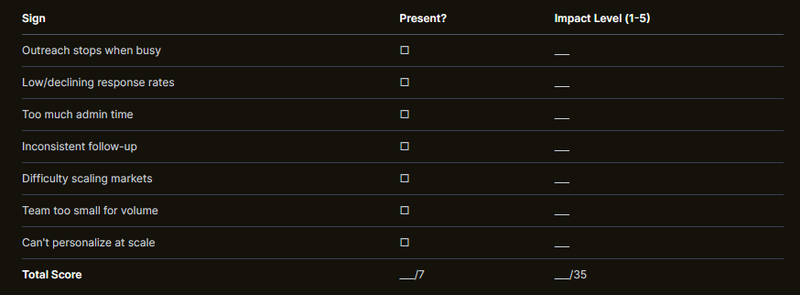
Interpretation Guidelines:
- 1-2 signs: Awareness phase—start planning for future automation needs
- 3-4 signs: Active planning phase—begin evaluating solutions and building business cases
- 5+ signs: Urgent action needed—current manual approach is significantly constraining growth
When the costs of manual methods—lost time, missed follow-ups, poor targeting, plateauing quotas, and inability to personalize at scale—materially impede growth, the assessment reveals critical mass for change. Different score ranges indicate varying levels of urgency for implementing automated solutions.
What Happens If You Ignore the Signs: The Cost of Inaction
Delaying action when multiple warning signs are present leads to predictable negative outcomes that compound over time. Small problems become major business constraints through escalating impact scenarios.
Short-term consequences (3-6 months) include missed individual opportunities and inconsistent pipeline development. Revenue becomes unpredictable with feast-or-famine cycles as gaps in outreach create future sales problems.
Medium-term impact (6-12 months) reveals revenue gaps from accumulated missed opportunities, team frustration from inefficient processes, and competitive disadvantages as faster competitors contact your prospects first. Significant revenue leakage occurs from missed follow-ups and inconsistent nurturing.
Long-term effects (12+ months) constraint business growth through limited market expansion, erosion of market position, and potential team turnover from ongoing frustration with manual processes. Companies become unable to scale beyond current team capacity while competitors gain sustainable advantages.
Real-world examples include service businesses losing new market opportunities to faster competitors, sales teams missing quotas due to administrative overhead consuming selling time, and companies unable to diversify revenue streams because manual processes can't support multi-market expansion.
These negative outcomes compound because manual systems become increasingly inadequate as business demands grow. What starts as temporary efficiency problems becomes systematic competitive disadvantages that are increasingly difficult to overcome.
When to Make the Switch: Timing Your Decision
Recognizing warning signs is the first step, but timing your transition to automated outreach requires considering organizational readiness factors beyond symptom recognition.
Readiness factors include:
- Clear understanding of current process problems and quantified costs
- Buy-in from key stakeholders and team members who will use systems
- Budget allocation for solution implementation, training, and optimization
- Realistic timeline that accounts for setup, testing, and refinement periods
- Commitment to testing and iterating on automated processes for optimal results
Optimal timing considerations:
- Best times: During planning cycles, after missing targets, when expanding into new markets
- Challenging times: During major organizational changes, budget freezes, or team transitions
- Recommended approach: Start with pilot programs before full implementation
Building your business case requires documenting current costs of manual processes including time investment, missed opportunities, and inefficiencies. Project ROI from automation through time savings, increased outreach volume, and improved conversion rates. Consider competitive advantages from faster, more consistent outreach and risk mitigation for future growth needs.
For businesses recognizing multiple signs, solutions like Local Leads provide comprehensive approaches to automated outreach with geographic targeting, continuous lead monitoring, and personalized messaging capabilities. Their tiered pricing structure allows gradual scaling from $49/month plans to enterprise solutions.
Getting Started with Automatic Cold Outreach Solutions
After recognizing warning signs and determining readiness, implement a clear action plan for transitioning to automated outreach systems.
Immediate action steps:
- Document Current State: Track existing metrics including response rates, time allocation, and follow-up consistency to establish baseline measurements.
- Quantify Impact: Calculate costs of current manual processes and estimate revenue from missed opportunities to build your business case.
- Define Requirements: List must-have features based on your specific warning signs and business needs, such as geographic targeting or industry segmentation.
- Evaluate Solutions: Compare options using criteria relevant to your situation, focusing on automation capabilities that address your primary concerns.
- Plan Implementation: Design rollout strategy with testing phases and optimization periods to ensure successful adoption.
For businesses experiencing these warning signs, Local Leads offers solutions that address multiple problems simultaneously. Start with their "open access" period to test platform capabilities, configure geographic and industry targeting for your specific markets, set up automated watch lists for continuous lead monitoring, and implement personalized email sequences using their automation tools.
Begin with pilot campaigns before full rollout to test effectiveness and optimize performance. Maintain compliance with email regulations and combine automation with human oversight for optimal results. Monitor performance data and adjust strategies based on response rates and conversion metrics.
The key is starting small with focused testing, then scaling successful approaches across your entire outreach operation.
Take Action Before Problems Compound
The seven warning signs we've explored are early indicators of systematic problems, not permanent business limitations. Recognizing these patterns early and taking action prevents larger problems while positioning your business for sustainable, scalable growth.
Manual outreach problems are incredibly common as businesses grow. The good news is they're entirely solvable with systematic approaches rather than hoping current processes will somehow improve on their own. Automated solutions like Local Leads address multiple warning signs simultaneously, providing consistent, scalable outreach that works even when your team gets busy.
Your next steps depend on your assessment results:
- 1-2 signs: Monitor trends and begin learning about automation solutions for future implementation
- 3-4 signs: Actively evaluate solutions and prepare for implementation within the next quarter
- 5+ signs: Take immediate action to address constraining factors that are limiting your growth
Don't let manual outreach limitations constrain your business growth. Take advantage of Local Leads' "open access" period to test how automated outreach can solve these specific challenges. Visit local-leads.ai to see how creating effective sales pipelines and automation address the warning signs you've recognized in your business.
Your success doesn't have to depend on finding more hours in the day or hiring expensive additional staff. Automated solutions provide the consistent, systematic approach needed for predictable revenue growth and sustainable competitive advantages.
FAQ Section
Q: How quickly can I expect to see results after implementing automatic cold outreach?
A: Most businesses see initial improvements in outreach consistency within the first week of implementation. Response rate improvements typically appear within 2-4 weeks as automated sequences begin reaching prospects consistently. Significant pipeline impact usually occurs within 60-90 days as automated follow-up sequences convert initial responses into qualified opportunities.
Q: Will automated outreach make my messages sound robotic or impersonal?
A: Modern automated outreach platforms like Local Leads use dynamic personalization based on prospect data, making messages more relevant than many manual efforts. The key is using automation for consistency and scale while incorporating genuine personalization based on prospect information, industry details, and business signals rather than just basic name insertion.
Q: How do I know if my team will adapt to using automated outreach tools?
A: Start with pilot programs involving your most tech-savvy team members to build internal success stories. Focus on how automation eliminates tedious tasks they already dislike (list building, data entry) while giving them more time for high-value activities they enjoy (relationship building, closing deals). Provide adequate training and emphasize that automation enhances rather than replaces their skills.
Q: What's the difference between automated outreach and spam?
A: Legitimate automated outreach targets relevant prospects with personalized, valuable messages and includes proper unsubscribe mechanisms. Spam involves mass messaging irrelevant recipients with generic content. Quality automated platforms provide targeting controls, personalization features, and compliance tools to ensure your outreach remains professional and legally compliant.
Q: Should I stop all manual outreach when implementing automation?
A: No, the most effective approach combines automation with strategic manual touchpoints. Use automation for initial outreach, consistent follow-up, and lead nurturing, while reserving manual efforts for high-value prospects, complex deals, and relationship building activities. This hybrid approach maximizes both efficiency and personalization where it matters most.