
How Small Businesses Can Compete With Big Players Using Local Leads
Published: 4/20/2026
How Small Businesses Can Compete With Big Players Using Local Leads
You're good at what you do. Your customers like you. Your work speaks for itself. But somehow, when a new neighbor searches for your service online, the big national brand shows up first. Their ad is at the top. Their listing looks polished. Their reviews number in the thousands.
It can feel like an unfair fight — because in some ways, it is. Large companies have bigger ad budgets, dedicated marketing teams, and enterprise-level tools that most small business owners have never even heard of. They can outspend you on paid search, outrank you in generic directories, and flood inboxes with branded emails before you've had your morning coffee.
But here's what they can't do: they can't know your neighborhood the way you do. They can't answer the phone and have the owner pick up. They can't pivot their entire strategy based on a conversation at a local event. And they can't build the kind of genuine community trust that a small business earns just by showing up, day after day, for the people around them.
This is where local leads become the great equalizer. Local leads are high-intent prospects in your immediate service area — people who are ready to buy, already nearby, and more likely to choose you if you reach them first. Tools like Local Leads (local-leads.ai) exist specifically to help small businesses and solo operators automate the process of finding and emailing local prospects, so outreach never falls off even when business is booming and your time is stretched thin.
This article covers the full picture: why big competitors seem to dominate, where their strategy actually falls apart, the eight most effective ways to generate local leads on a small budget, a 90-day action plan, and how to measure whether it's all working.
Before we get into the tactics, let's look at exactly why big competitors seem to dominate — and where they're actually weaker than you think.
Key Takeaways
- Local leads convert better because proximity builds trust and reduces friction, making them your most efficient source of new customers.
- Small businesses have real, exploitable advantages over large brands: agility, personalization, community ties, and niche focus.
- A handful of high-impact, low-cost tactics — Google Business Profile optimization, geo-targeted ads, referral programs, and automated email outreach — can generate a consistent pipeline without a dedicated sales team.
- Responding to a new lead within 15 to 60 minutes dramatically increases your chances of closing, and automation makes this possible even when you're tied up.
- You don't need a big budget or a sales team to compete. You need a repeatable system.
Why Big Companies Dominate Local Markets (And Where Their Armor Has Cracks)
How Large Players Crowd Out Small Businesses
Large corporations use scale, price, and distribution to saturate local marketing channels. Their corporate ad budgets fund dominant local search visibility through broad pay-per-click campaigns, display networks, and social media saturation — channels that are expensive to compete on head-to-head when you're working with a modest monthly budget.
Beyond digital advertising, big brands can lock up premium physical locations, secure exclusive supplier deals, and claim top placement on digital platforms like Google and Yelp through sheer volume and spend. The result is that small businesses often feel invisible in their own backyard, crowded out by brands that may not even have a local employee on the ground.
This visibility gap creates a real perception problem. Consumers assume that what they see first is what's best. If your business doesn't appear on the first page of local search results, a large portion of your potential customers never find you — no matter how good your work actually is.
The Cracks in the Big-Brand Armor
Here's the truth that most small business owners miss: large companies optimize for broad markets. They almost never go deep at the neighborhood or street level. A national home services franchise has no playbook for the specific concerns of homeowners in one particular zip code. They can't mention a local school by name in an ad. They can't send a follow-up email that references a conversation from last week's community market.
Large companies also struggle to offer genuine personalization. Their customer service is often scripted, routed through call centers, or automated in ways that feel cold and impersonal. Corporate bureaucracy slows decision-making — they can't pivot quickly to a local trend, a competitor's promotion, or a sudden shift in customer needs.
Most importantly, they lack authentic local roots. And as Entrepreneur notes: "Small businesses can succeed by exploiting differences in agility, community ties, personalization, and niche focus."
Those cracks are exactly where a focused local lead strategy can break through — and the advantages small businesses already hold are more powerful than most owners realize.
The Natural Edge Small Businesses Already Have
You Can Move Faster
When a competitor runs a promotion, a big brand's response goes through legal, compliance, regional management, and corporate approval. Yours takes an afternoon. Small businesses can test a new tactic, change a message, or pivot a campaign in hours, not months. That agility means you can react to local events, seasonal trends, and neighborhood changes before any large competitor even notices they exist.
You Can Go Deeper Into a Niche
Large brands are built for scale, which means they optimize for the broadest possible audience. That leaves narrow niches and hyperlocal segments completely unclaimed. A small business can own "plumber in [specific neighborhood]" or "family dentist near [local school]" in a way a national chain simply never will. Google rewards this kind of specificity, and so do customers.
You Can Offer Real, Human Service
When a customer calls your business, they can speak directly to the person doing the work. That's something a call center can never replicate. Personalized service builds repeat business and word-of-mouth referrals — which are free leads that compound over time. A customer who trusts you becomes your best marketing channel.
You Have Community Capital
Sponsoring a local event, knowing your customers by name, or being featured in a neighborhood newsletter builds trust that no ad budget can manufacture. Authentic local stories and visible community involvement attract value-driven consumers who actively prefer to buy local. That preference is not a small thing — research consistently shows that consumers trust local businesses more than national chains for personalized service.
Here's a practical example: Bean & Brew, a small independent coffee shop, focused on Google Business Profile optimization, structured review collection, and local partnerships with nearby businesses. Within months, they were outranking larger chains for highly local search queries and generating double-digit foot-traffic growth — without a dollar spent on national advertising.
The edge is real — but it only works if you channel it into a system that consistently generates and follows up on local leads. Here's exactly how to do that.
What Are Local Leads (And Why They're Different)
A Simple Definition
Local leads are prospective customers in your immediate service area who have shown — or are likely to show — interest in what you offer. They differ from broad, national leads because proximity increases convenience, trust, and the actual likelihood of a purchase.
A plumber generating leads from a generic home improvement website might receive inquiries from three states. A plumber generating local leads gets inquiries from people two miles away who need a pipe fixed today.
Why Local Leads Convert Better
The conversion advantages are practical and measurable:
- Higher intent: People searching locally are often ready to act now. "Emergency HVAC repair near me" is not a casual inquiry.
- Lower friction: It's easy for a local prospect to visit, call, or book. There's no shipping delay, no unfamiliar brand, no hesitation about distance.
- Better retention: Local customers are more likely to return and refer friends in the same area — compounding your lead generation over time.
- Better ROI: Concentrating spend on geographically relevant audiences means less wasted budget and more meaningful conversations with people who can actually buy.
Now that we understand what local leads are and why they matter, here are the most effective ways to generate them — even without a dedicated sales team.
8 Proven Ways to Generate Local Leads on a Small Budget
1. Optimize Your Google Business Profile — The #1 Free Lead Tool
What it is: A free listing on Google that displays your business in local search results and on Google Maps when someone searches for your service nearby.
Why it works: Local SEO drives the most intent-rich organic traffic for nearby searchers, and your Google Business Profile (GBP) is the foundation of all of it. It's where customers find your hours, read your reviews, see your photos, and decide whether to call you.
How to start:
- Claim and verify your profile at business.google.com
- Complete every field: business name, address, phone number (NAP), hours, service areas, photos, and service descriptions
- Keep your NAP consistent across every platform where your business appears
- Post updates regularly — offers, events, seasonal promotions, new services
- Ask every satisfied customer for a review, and respond to all reviews, both positive and negative
Real-world result: A San Diego environmental testing company used city-level local SEO and GBP optimization to generate a 220% increase in organic traffic and nearly $1M in attributed lead value. That's the power of getting your local foundation right.
2. Run Small, Geo-Targeted Paid Ads
What it is: Search or social ads that only show to people in a specific zip code, city, or radius around your business.
Why it works: You only pay to reach people who can actually become customers. There's no wasted budget on users in other states who will never call you.
How to start:
- Use Google Local Services Ads (pay per lead, not per click) for service businesses — you can find them at ads.google.com/local-services-ads
- Use Google Search Ads with tight location targeting and your top two or three services as keywords
- Use Facebook and Instagram geo-targeted Lead Form ads for specific neighborhoods — reference local landmarks in your copy to make them feel personal
- Start with a $10 to $20 per day test budget, track your cost per lead, and scale only what works
3. Build a Simple Referral Program
What it is: A structured incentive that rewards current customers for introducing new ones.
Why it works: Referrals arrive with built-in trust. They convert faster and at lower cost than cold leads because someone the prospect already trusts has vouched for you.
How to start:
- Offer a simple reward: a discount, gift card, account credit, or locally relevant perk
- Mention the referral program at every point of sale — in person, in follow-up emails, and on receipts
- Partner with two or three complementary local businesses for mutual referrals (a landscaper and a fence installer, for example, or a bookkeeper and a business attorney)
- Track referrals in a simple spreadsheet or free CRM
4. Create Local Content and Landing Pages
What it is: Web pages and blog posts written specifically for your city, neighborhood, or local community — not just your industry in general.
Why it works: Google rewards hyperlocal relevance. A page titled "Roof Repair in [Neighborhood Name]" can outrank a national brand's generic service page because it's more relevant to the searcher.
How to start:
- Create one landing page per service area or neighborhood you serve
- Write a short blog post answering a common local question, such as "How much does [service] cost in [City]?"
- Include a clear call to action on every page — "Book a free consultation in [City]"
- Get listed in local online directories and sponsor a local organization in exchange for a backlink to your site
5. Use Community Events and Local Partnerships
What it is: Showing up in person at events, markets, workshops, or community meetups where your target customers already gather.
Why it works: In-person connection builds trust faster than any digital channel. Event attendees are self-selected prospects with relevant interests — they showed up because they care about the topic.
How to start:
- Host a free workshop or Q&A session on a topic your customers care about
- Sponsor a local event, sports team, or charity drive
- Set up a QR code signup at your table to collect contact information on the spot
- Follow up within 24 to 48 hours with a personalized email that references the event
6. Add Live Chat or a Simple Chatbot to Your Website
What it is: A chat widget that greets website visitors, answers basic questions, and captures contact details before they leave.
Why it works: Many visitors leave your site without ever calling. A chat prompt catches them in the moment, qualifies them instantly, and routes them into your follow-up system.
How to start:
- Use a free or low-cost tool like Tidio, HubSpot Chat, or Intercom
- Set up automated responses for your most common questions — pricing, availability, service area
- Route all captured leads directly into your CRM or email list
- Set a firm follow-up rule: anyone who chats gets an email or call within 15 to 60 minutes
7. List Your Business on Paid Directories and Marketplaces
What it is: Platforms like Yelp, Angi, and Thumbtack that connect local buyers with service providers.
Why it works: These platforms already have high-intent traffic. You're positioning yourself where people are actively searching for your specific service, often with credit card in hand.
How to start:
- Claim and fully complete your profile on platforms relevant to your industry
- Invest in paid placement only where the cost per lead is profitable — not all platforms will work for all businesses
- Track each platform separately and pause any that consistently fail to convert
- Actively collect and respond to reviews to improve your platform ranking
8. Follow Up With Retargeting Ads
What it is: Ads shown specifically to people who already visited your website but did not reach out or book.
Why it works: Most visitors don't convert on the first visit. Retargeting keeps your business top of mind until they're ready to take action — often just a small nudge away from calling you.
How to start:
- Install the Facebook Pixel and Google Ads tag on your website
- Create a simple retargeting ad with a neighborhood-specific offer or limited-time promotion
- Include urgency: "Still looking for [service] in [City]? Book this week and save 10%"
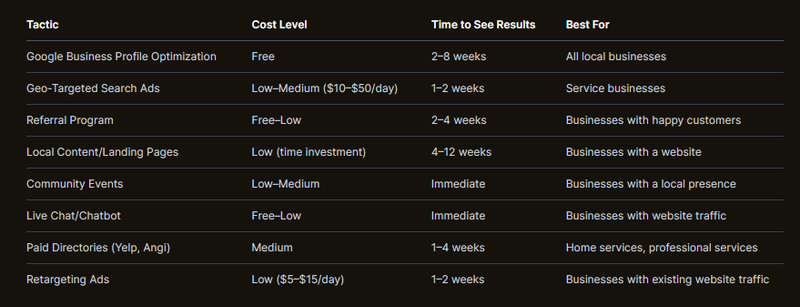
These tactics work even better when you have a system that finds new local prospects for you automatically — which is exactly what we built at Local Leads.
How Local Leads Helps You Automate This Entire Process
The Problem We Built This to Solve
Here's what happens to almost every small business owner: when business is good, outbound sales falls off the radar entirely. You're busy doing the work — quoting, delivering, following up on active projects — and when things slow down, you look up and realize your pipeline is empty.
Manual prospecting takes hours. Building lists, finding emails, writing personalized outreach — it's essentially a full-time job that most small teams simply don't have time for. And hiring a business development rep to handle it costs $50,000 to $80,000 or more per year. For most small businesses, that's not a realistic option.
What Local Leads Does
We built Local Leads to solve exactly this problem. It's a platform that continuously finds new local business leads — filtered by your industry and geographic area — and automatically sends personalized emails to them before your competitors do.
You set up your target geography and industry, and the platform runs on autopilot. No manual list-building. No CRM uploads. No hours spent chasing down contact information. Our search algorithms monitor for new local businesses matching your criteria, collect complete contact data including emails, phone numbers, and social profiles, and then immediately trigger personalized outreach on your behalf.
The "First to Inbox" Advantage
Speed is everything in local lead generation. The first business to reach a new prospect holds a major advantage — and our platform is designed to get you there first, often before a competitor even knows the prospect exists. Businesses that implement automated, timely local outreach consistently report higher close rates, simply because they're showing up first and doing it consistently.
A dental practice that combined local SEO with targeted advertising saw 29% growth in new patients. One business using AI-driven local SEO and automated GBP optimization saw a 340% increase in local leads in just six weeks. The common thread in both cases: showing up early, showing up consistently, and making it easy for the prospect to take the next step.
Plans That Work for Small Teams
Our $49 per month Starter plan gives you 3 active watch lists, 20 new lead searches, and 500 emails per month — more than enough to run a consistent outbound program without a sales team behind it. Our most popular $99 per month plan scales that to 10 watch lists, 50 searches, and 3,000 emails per month.
There's currently an open access period where you can try the platform free. Visit local-leads.ai to get started.
Whether you use a platform like Local Leads or build your outreach process manually, the next step is making sure your system is set up to measure and improve over time.
How to Measure Whether Your Local Lead Strategy Is Working
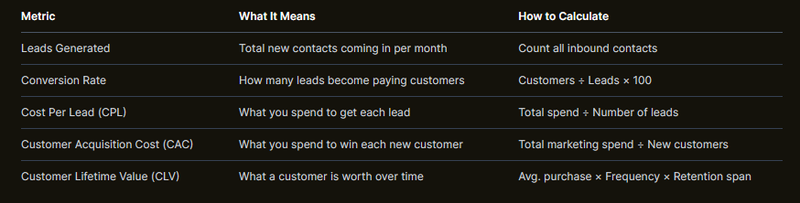
The 5 Numbers You Need to Track
You don't need a complicated dashboard or a dedicated analyst. You need five consistent metrics, checked regularly, so you always know what's working and where to focus.
A Simple ROI Calculation You Can Do Right Now
Here's the formula: ROI (%) = (Revenue from campaign minus Cost of campaign) divided by Cost of campaign times 100
A practical example: Suppose you spend $15,000 on marketing plus $2,500 in follow-up costs — $17,500 total. That campaign generates 1,000 leads and closes 100 sales, with an average profit of $300 per sale. Total campaign profit is $12,500. Your ROI works out to 71.4%.
Even rough estimates are useful. Plug in your own numbers to identify which channels deserve more investment and which ones are quietly draining your budget.
Which Metric Matters Most Right Now
The right metric to focus on depends on where you are in your growth:
- Just starting out? Focus on CPL. Find the cheapest channel that delivers quality leads before trying to scale anything.
- Getting leads but not closing? Focus on conversion rate. Review your follow-up speed first — if you're not responding within an hour, you're likely losing business to faster competitors.
- Closing consistently but not growing? Focus on CLV. Increase retention, ask for referrals, and build programs that reward customers for coming back.
Measurement tells you what's working — but getting started is what matters most. Here's a simple 90-day plan to put everything in this article into action.
Your 90-Day Local Lead Generation Plan
Days 1–14: Build the Foundation
Before you spend a dollar on ads or outreach, make sure your foundation is solid:
- Claim and fully complete your Google Business Profile — NAP, photos, services, hours, and service area descriptions
- Install Google Analytics 4 (GA4) and the Facebook Pixel on your website so you can track what's actually working
- Connect your contact forms and lead sources to a free CRM — the HubSpot free tier is a strong starting point
- Create one localized landing page for your top service with a clear call to action ("Book a free [service] consultation in [City]")
- Set up a follow-up rule: every new lead gets a response within 60 minutes, automated if possible using a simple email sequence
Days 15–45: Activate and Reach Out
With your foundation in place, start generating leads:
- Launch a small geo-targeted search campaign using Google Local Services Ads or Search Ads for one or two core services — set a clear CPL target so you know when it's working
- Add a live chat widget or chatbot to your website and connect it to your CRM
- Launch a referral program and personally tell your best five to ten current customers about it
- Reach out to three complementary local businesses about a mutual referral arrangement
- Start automated local email outreach to new prospects in your area — this is where a tool like Local Leads saves hours of manual prospecting each week
Days 46–90: Optimize and Scale
Now that leads are coming in, focus on improving quality and efficiency:
- A/B test your top landing page with two different headlines or calls to action — see which one drives more conversions
- Run a local event, free workshop, or community meetup — collect attendee contact details and follow up with a targeted offer
- Launch a review collection campaign: email or text every recent customer and ask for a Google review
- Add two to three additional neighborhood service pages to your website to capture more local search traffic
- Review your five key metrics at the 90-day mark and double down on whatever produced the highest ROI

Having a plan is great — but even the best plans fail without a few key habits in place. Here are the daily practices that separate businesses that grow from those that plateau.
Daily Habits That Keep Your Local Lead Pipeline Full
Respond Fast, Every Time
Responding to a new lead within 15 to 60 minutes dramatically increases your chance of closing. Set up automated first-touch messages so this happens even when you're tied up with a job. Think about it from the prospect's perspective: if they fill out a contact form and hear nothing for four hours, they've almost certainly already called someone else.
Keep Your Messaging Hyperlocal
Reference neighborhoods, nearby landmarks, or local community events in your ad copy, email outreach, and GBP posts. "We've worked with 15 businesses on [Local Street/Area] this year alone" is far more persuasive to a local prospect than any generic value proposition about quality or experience.
Reinvest Early Wins
When your first campaign produces leads and sales, reinvest a portion of that profit into your highest-performing channel. The math compounds quickly: $300 in ad spend that generates $900 in revenue, reinvested at the same rate, grows your pipeline without requiring significant capital infusion.
Never Stop Asking for Reviews
Reviews are free leads. They improve your GBP ranking, build trust with cold prospects, and accelerate purchase decisions. Make review requests a standard step after every completed job or sale — not something you think about only when things slow down.
Common Challenges and How to Overcome Them
"I Don't Have a Big Budget"
Start with Google Business Profile optimization, which costs nothing. Then consider Google Local Services Ads, where you pay per lead rather than per click. Partner with other local businesses to share event costs and cross-promote — both businesses benefit at roughly half the cost.
"I'm Getting Leads But They're Not Converting"
Add qualification questions to your contact forms or chatbot to filter out low-fit prospects before they take up your time. Then review your follow-up speed — if you're not responding within an hour, you're almost certainly losing business to faster competitors.
"I Can't Stand Out Against Big Brand Names"
Double down on what big brands cannot replicate: use real customer photos, neighborhood-specific case studies, and owner-written content. Offer something a franchise will never provide — a direct line to the person doing the actual work.
"I Don't Have Time to Learn New Tools"
Start with one tool, not ten. Google Business Profile combined with a free CRM like HubSpot is enough to begin generating and tracking leads. Use automation tools like Zapier to connect the tools you already have and handle repetitive tasks, freeing you to focus on selling and service delivery.
Real Small Businesses That Beat Bigger Competitors
The Coffee Shop That Outranked a National Chain
Bean & Brew, a local independent coffee shop, used GBP optimization, structured review collection, and local partnerships to outrank larger chains in their city's local search results. The result was double-digit foot-traffic growth within months — without a single dollar spent on national advertising campaigns.
The Environmental Testing Company That Found $1M in Leads
A San Diego environmental testing company invested in city-level local SEO, fixed technical website issues, and added proper conversion tracking across their digital properties. Within months, organic traffic grew by 220%, and the leads generated were attributed to nearly $1M in business value — proof that a disciplined local SEO strategy can produce enterprise-level results for a small operation.
The Service Business That Automated Its Way to Scale
A pool construction business used CRM automation and structured lead follow-up, implemented through Thryv, to fully systemize their sales pipeline. Sales scaled dramatically once they stopped relying on manual follow-up and let automation handle first contact — freeing the team to focus on closing and delivering work.
The 340% Lead Increase in 6 Weeks
One business combined AI-driven local SEO with automated GBP optimization and saw a 340% increase in local leads in just six weeks. The key driver was consistent, automated outreach to the right local audience at the right time — not a larger budget or a bigger team.
Bringing It All Together
The big guys will always have larger budgets. That's not going to change. But they will never have your community roots, your ability to answer the phone personally, or your capacity to pivot based on a single customer conversation. Those advantages are real, and in a local market, they matter more than most small business owners realize.
The playing field is more level than it looks when you focus on local leads and use the right system to capture and follow up on them consistently. Optimize your Google Business Profile. Run small, targeted ads. Build referral relationships. Create local content. Automate your outreach so it never falls off when business picks up and your time disappears.
You don't need a sales team or a massive budget. You need a repeatable system that keeps your pipeline moving whether you're in the middle of your busiest week or your slowest one.
The businesses that win locally in 2026 and beyond won't be the ones with the biggest ad spend. They'll be the ones who show up first, follow up fast, and build real relationships in their community.
Start with one action today. Claim your Google Business Profile if you haven't already. Set up an automated outreach list. Or visit local-leads.ai to try the platform free and see how quickly a consistent local lead system can change the trajectory of your business.
Frequently Asked Questions
What is a local lead, and how is it different from a regular lead? A local lead is a prospective customer located within your service area who has shown interest — or is likely to show interest — in your product or service. Unlike broad leads, local leads convert at higher rates because proximity reduces friction, builds trust, and makes it easy for the prospect to take immediate action.
How much should a small business spend on local lead generation? You can start generating local leads with zero paid budget by optimizing your Google Business Profile and asking for referrals. When you're ready to add paid tactics, Google Local Services Ads and geo-targeted search ads are efficient starting points at $10 to $20 per day. Focus on tracking your cost per lead so you scale only what's producing results.
How quickly should I follow up with a new lead? As quickly as possible — ideally within 15 to 60 minutes of first contact. Research consistently shows that response time is one of the strongest predictors of whether a lead converts. Automated first-touch emails or texts make it possible to respond instantly, even when you're in the middle of a job.
Can a small business really outrank a national brand in local search? Yes — and it happens regularly. National brands optimize for broad, general search terms. A small business that builds hyperlocal content, maintains a well-optimized Google Business Profile, and collects consistent local reviews can outrank national chains for neighborhood-level and city-level search queries.
What's the easiest way to start automating local lead outreach? The simplest starting point is combining a free CRM (like HubSpot) with a basic email sequence triggered when a new contact enters your system. For more proactive outreach to new local prospects, platforms like Local Leads (local-leads.ai) automate the process of finding, contacting, and following up with local businesses in your target area — without manual list-building or prospecting.